Policies

1. Revised Corporate Governance Manual (“RCGM”)
The Company’s RCGM institutionalizes the principles of good corporate governance throughout the organization. It lays the foundation for the Company’s compliance system and identifies the roles and responsibilities of the Board and Management, as well as the rights of all shareholders, including minority shareholders, and the protection of their interests. Likewise, it requires adoption of and/or discloses the Company policies, such as: 1) Anti-Bribery and Anti-Corruption; 2) Board Diversity; 3) Board Nomination and Election; 4) Conflict of Interest; 5) Dividend Policy; 6) Material Related Party Transactions; 7) Stakeholders Health, Safety, and Welfare; 8) Whistleblowing; and 9) Succession Planning and Remuneration, among others.
The RCGM, company policies, Board and Committee Charters, and the Corporate Governance organizational structure are regularly reviewed to ensure compliance with regulatory issuances and to keep pace with the constant development of corporate governance best practices. Continuous improvement and monitoring of governance and management policies have been undertaken to ensure that the Company observes good governance. The Company also consistently strives to raise its financial reporting standards by adopting and implementing the prescribed Philippine and International Financial Reporting Standards.
2. Code of Business Conduct and Ethics (“Code”)
The fundamental principle of this Code is the expectation that all JGSHI directors, officers, employees, subsidiaries, and affiliates conduct their dealings in the best interests of the Company and in accordance with the highest legal and ethical standards while maintaining a firm stance against corrupt practices. Thus, everyone must adhere to the Company’s core values, acceptable norms, and policies indicated in the Code in all of the Company’s business activities and future endeavors.
Compliance Reports
1. Integrated Annual Corporate Governance Report (“I-ACGR”)
In compliance with SEC Memorandum Circular No. 15 series of 2017 for all publicly listed companies to disclose the Company’s compliance or non-compliance with the recommendations provided under the CG Code, the Company submitted the 2024 I-ACGR to the SEC and PSE on May 29, 2025. This can be accessed in the Governance section of its website under Compliance Reports - IACGR.
2. Compliance Manual
The Company has a compliance program or manual, approved on March 29, 2023, which outlines adherence to applicable laws, regulations, and internal policies. It is subject to regular review to ensure its continued relevance and effectiveness. The manual has the following contents: 1) Compliance System; 2) Compliance Structure; 3) Compliance Program; 4) Compliance Review; and 5) Compliance Training and Awareness initiatives.
Governance Framework
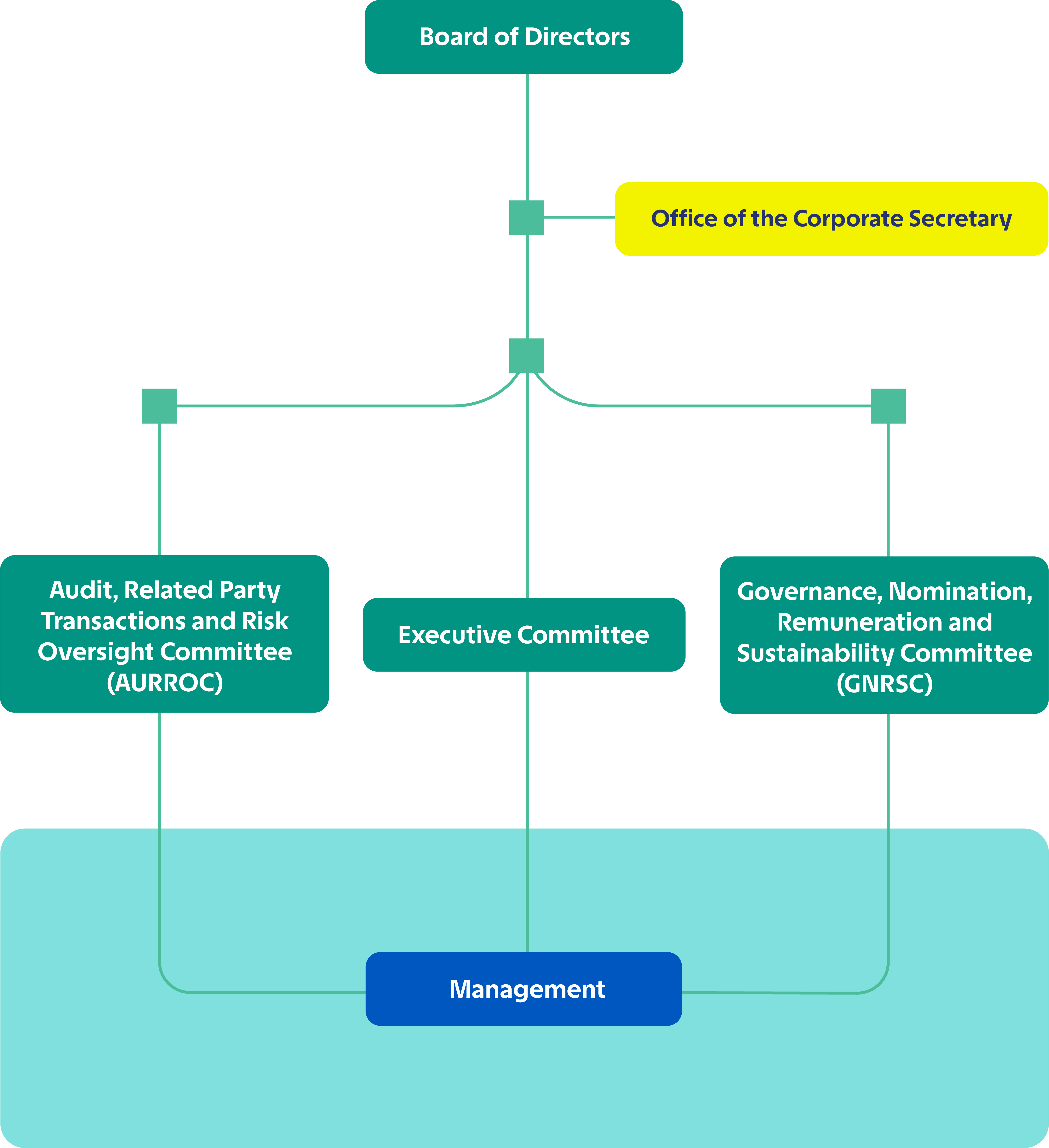

Click the diagram to view
The governance framework of JGSHI is fundamental to ensuring that it operates in alignment with its core values of Entrepreneurial Mindset, Stewardship, and Integrity. At the heart of this structure is the Board, which plays a critical role in providing strategic direction and overseeing the Company’s governance, including its overall strategy, Enterprise Risk Management (“ERM”) effectiveness, sustainability initiatives, climate-related risks, and opportunities.
To support the Board in effectively fulfilling its roles and responsibilities, several Board Committees have been established, including: 1) the Audit, Related Party Transactions, and Risk Oversight Committee (“AURROC”), 2) the Executive Committee (“ExCom”), and 3) the Governance, Nomination, Remuneration, and Sustainability Committee (“GNRSC”). Further details regarding the AURROC and GNRSC are provided in the “Board Committees” section of this Sustainability Report.
The Board and its Committees are supported by the Office of the Corporate Secretary, which plays a key role in facilitating communication between the Board, Board Committees, Management, and shareholders.
Moreover, the Board and its Committees work closely with Management to ensure that the Company achieves its objectives and strategic goals. The roles of the key officers of Management, outlined in the “Management Leadership Chart” section of this Report, are discussed below:
The President and CEO oversees the Company’s operations and manages its human and financial resources in accordance with the strategic plan. He also provides leadership to Management in determining, developing, and implementing business strategies, plans, and budgets to the extent approved by the Board. He provides the Board with a balanced and understandable account of the Company’s performance, financial condition, operational results, and prospects on a regular basis. He defines the overall strategic direction for the conglomerate, encompassing its approach to sustainability and climate action. The President and CEO plays a pivotal role in driving initiatives, managing risks, and ensuring transparent reporting on performance.
The Corporate Secretary assists the Board and its Committees in conducting their meetings by preparing the annual schedule of Board and Committee meetings and the annual Board calendar. She also assists the Chair and its Committees in setting meeting agendas, attending Corporate Governance trainings, and safeguarding and preserving the integrity of the minutes of the Board and Committees’ meetings, as well as other official records of the Company. The Corporate Secretary is a lawyer by profession and possesses all the qualifications and none of the disqualifications to hold the position.
The Chief Finance and Risk Officer (“CFRO”) leads the financial reporting, controllership, and corporate forecasting functions, guiding the Company to make sound business and financial decisions. He ensures a sound ERM framework is in place to effectively identify, monitor, assess, and manage key business risks, including sustainability and climate-related risks. He communicates significant risk exposures, control issues, and risk mitigation strategies to the AURROC. Under the risk and controls function, the CFRO is the steward of risk management, specifically those that have financial impact and affect Company value.
The Chief Legal Officer (“CLO”) offers expert, strategic legal advice to senior management and oversees all legal and regulatory matters within the Company. She plays a pivotal role in safeguarding the Company’s legal interests, particularly in labor law, mergers and acquisitions, litigation, and other commercial and corporate matters. Additionally, she ensures the organization complies with all relevant laws and regulations. The CLO also manages legal and regulatory risks and leads the in-house legal team.
The Chief Audit Executive (“CAE”) oversees the implementation of the Internal Audit Charter and the annual risk-based Internal Audit Plan and submits these to Senior Management and the AURROC for review and approval. The CAE ensures effective coordination with other internal and external assurance providers and communicates any significant resource limitations that may affect the delivery of the audit plan. The CAE is responsible for ensuring that internal audit activities adhere to Company policies, applicable internal auditing standards, and leading practices. The CAE provides independent and objective assessments to the AURROC, Management, and external stakeholders on the adequacy and effectiveness of the Company’s governance, risk management, and internal control processes.
The Chief Human Resources Officer (“CHRO”) oversees the conglomerate’s sustainability efforts, particularly by developing climate and sustainability strategies, leading disclosure initiatives, and embedding sustainability in the organization’s culture.
The Sustainability Head reports to the CHRO and is tasked with designing and leading the development of the Company’s Climate Resilience and Transition plans, identifying relevant risks and opportunities, and helping SBUs achieve related targets. The Sustainability Head provides strategic direction, builds stakeholder relationships, and monitors performance. The Sustainability Head collaborates with the ERM and Corporate Strategy teams to integrate sustainability and climate-related risks and opportunities into the Company’s strategy and risk management framework. Additionally, the Sustainability Head engages with relevant internal and external stakeholders to discuss and build support for key sustainability-related initiatives and policies.
The Chief Strategy Officer (“CSO”) is responsible for assisting the Board and CEO in overseeing the Company’s long-term OGSM and ensuring its effective implementation in line with the business environment and culture. He ensures that sustainability and climate considerations are integrated into the Company’s broader business strategy and that ecosystem synergies are maximized. The CSO also participates in investor conferences, roadshows, and other engagement platforms to communicate the Company’s strategy, goals, and progress directly to investors.
The Investor Relations Officer is tasked with effectively managing two-way communication between the capital markets and the JGSHI leadership team to drive shareholder value maximization.
The Chief Compliance Officer (“CCO”) monitors, reviews, evaluates, and ensures compliance by the Company, its directors, officers, and employees with the provisions and requirements of the relevant laws, rules, and regulations. She also attends Corporate Governance trainings, ensures the integrity and accuracy of all documentary submissions to the regulators, identifies potential compliance issues, and works towards their resolution. She assists the Board and the GNRSC in performing their governance functions, including overseeing the development, review, and implementation of the Company’s Corporate Governance framework and policies.
The Board of Directors
A. Responsibilities of the Board
The Board is primarily responsible for the Company's governance. A competent and working Board heads JGSHI to ensure the Company’s unremitting success and sustain its competitiveness and profitability in a manner consistent with its OGSM and the long-term best interests of shareholders and other stakeholders. They exercise care, exceptional skill, and sound judgment, as well as observe good faith and loyalty in the conduct and management of the Company’s businesses and affairs. This ensures that all the Company’s actions are within the scope of power and authority prescribed in the Articles of Incorporation, By-Laws, and existing laws, rules, and regulations. Accordingly, the Board performs its duties and responsibilities conscientiously and with honesty and integrity, in accordance with and as disclosed in the Company’s RCGM, Board and Committee Charters, and policies.
1. Roles and Functions
a. The Chairman
The Board is headed by a competent and qualified Chairman who presides over all Board and shareholder meetings. He also assists in implementing and ensuring compliance with corporate governance policies and practices. He ensures that the agenda focuses on strategic matters and guarantees that the Board receives accurate, timely, relevant, insightful, concise, and clear information to enable it to make sound decisions.
The detailed duties and responsibilities of the Chairman are outlined in the RCGM.
In JGSHI, the position of the Chairman of the Board is separate from the President and CEO to further strengthen the Board’s independence. This is to ensure a clear distinction between the Chairman’s responsibility to manage the Board that exercises corporate powers and conducts business, and the CEO’s responsibility to manage the executives that implement the policies in the conduct of the business in accordance with the Company’s By-Laws and RCGM. The Chairman of the Board is Mr. James L. Go, while the President and CEO is Mr. Lance Y. Gokongwei.
b. Independent Directors (“IDs”)
The Board has Independent Directors, who occupy four out of the nine Board seats, or more than one-third (1/3) of the Board members, and who possess all the necessary qualifications and none of the disqualifications to hold the position. They are independent of management and the controlling Shareholders and are free from any business or other relationship that could, or could reasonably be perceived to materially interfere with their exercise of independent judgment in carrying out their responsibilities as Directors.
c. Lead Independent Director
The Company’s RCGM provides that the Board may designate a Lead Independent Director among the Independent Directors if the Chairman of the Board is not an Independent Director and if one person holds the positions of Chairman of the Board and CEO. His role is to lead the independent directors and to guide the Board in cases where conflicts of interest may arise.
On May 14, 2025, the Board re-appointed ID Antonio L. Go as the Lead ID to perform the following functions: 1) to serve as an intermediary between the Chairman and the other directors when necessary; 2) to convene and chair meetings of the Non-Executive Directors (“NEDs”); and 3) to contribute to the performance evaluation of the Chairman, as required.
B. Composition and Qualification
1. Incumbent Board (2025 Individual Profiles)
The Directors’ biographical details are set out in the JGS Annual Report SEC Form (17A) December 2025, Part III Control and Compensation Information, Item 9, Directors or Leadership page of the Annual/Sustainability Report.
Chairman
James L. Go (Non-Executive and Non-Independent Director)
Lead Independent Director
Antonio L. Go (Non-Executive and Independent Director)
Members
- Lance Y. Gokongwei (President and CEO)
- Robina Gokongwei-Pe (Non-Executive and Non-Independent Director)
- Patrick Henry C. Go (Executive and Non-Independent Director)
- Johnson Robert G. Go, Jr. (Non-Executive and Non-Independent Director)
- Artemio V. Panganiban (Non-Executive and Independent Director)
- Bernadine T. Siy (Non-Executive and Independent Director)
- Antonio Jose U. Periquet, Jr. (Non-Executive and Independent Director)
2. Board Diversity
The Company recognizes the benefits of having a diverse Board and its value in maintaining sound corporate governance while achieving strategic objectives and sustainable growth. Board diversity shall be considered from varied aspects when structuring the Board’s composition, including, but not limited to, gender, age, culture and educational background, geographical location, professional experience, skills, knowledge, and the length of service of directors, among others. Likewise, in the implementation of its Board Diversity Policy, JGSHI does not discriminate by reason of ethnicity, nationality, political, or religious background of its directors, officers, and employees. Specifically for the Board, when searching for candidates for a director, the Company uses professional search firms or other external sources as a policy. Thus, the incumbent Board is diverse in terms of expertise, gender, professional experience, and academic backgrounds.
In line with the RCGM, Board Diversity Policy, and Nomination and Election Policy framework, GNRSC reviewed the Board’s structure, size, and composition. In accordance with its objective of having at least four Non-Executive IDs, including one female, with diverse backgrounds beneficial to the Company's business that possess all necessary qualifications, Ms. Bernadine T. Siy was elected to the Board during the ASM on May 15, 2025. Currently, there are two female directors on the Board: one Non-Executive ID and one Non-Executive Non-ID.
3. Nomination and Election
The Company’s directors are elected at the ASM to serve until the next annual meeting and until their respective successors are elected and qualified. In 2025, the Board’s composition, with all members meeting the necessary qualifications and none of the disqualifications, is as follows: three NEDs, four IDs, and two Executive Directors, including the President and CEO.
4. Board Competencies (Matrix)
Each Director provides a unique business perspective, experience, and skill set that are all valuable to the Company.
*Data on age is from the JGS Annual Report SEC Form (17A) December 2025, Part III, Item 9 (1) Directors.
C. Board and Board Committee Meetings
1. General Requirements: Quorum, Notification, Frequency
The Board diligently makes informed and prudent decisions, consistently acting in the best interests of the Company and its shareholders. The Company requires a quorum of 2/3 for Board decisions, except for the election of officers, which requires a vote by a majority of all Board members. In accordance with the Company’s By-Laws, board meetings are scheduled in the last quarter of the preceding year, with regular sessions held and special meetings convened when required by business exigencies. The Board receives meeting notices, agendas, and other relevant meeting materials at least five business days prior to each meeting to allow for review before said meetings. As seen in the Certificate of Attendance of Meetings uploaded to the website, all incumbent Directors have complete attendance for 2025.
In 2025, the Board met 15 times, with a quorum (2/3 of the number of Directors) in all meetings. There was a total of nine Board Committee meetings in 2025: five AURROC Meetings and four GNRSC meetings, which included updates on Governance and Sustainability. All the members of the Board were likewise present in the ASM.
On August 7, 2025, under the chairmanship of Mr. Go as the Lead Independent Director, the NEDs and IDs met without executives present. Likewise, on November 6, 2025, they met with the External Auditor, CAE, CFRO, and CCO. On the same date, the IDs, who are members of AURROC, met with the External Auditor without any management present.
2. Attendance in Board Meetings and ASM
10 - Special meetings; 4 – Regular meetings; 1- Organizational meeting
*Mr. Antonio Jose U. Periquet, Jr. replaced Mr. Renato T. De Guzman
3. Attendance in Board Committee Meetings
Audit, Related Party Transaction, Risk Oversight Committee (AURROC) Meetings
Governance, Nomination, Remuneration, and Sustainability Committee (GNRSC) Meetings
*Mr. Antonio Jose U. Periquet, Jr. replaced Mr. Renato T. De Guzman
D. Board Committees
For a better and more focused attention on the affairs of the Company and to aid in the optimal performance of its roles and responsibilities, the Board approved the delegation of particular matters to two Board Committees, namely: 1) AURROC; and 2) GNRSC.
1. Audit, Related Party Transactions and Risk Oversight Committee (“AURROC”)
a. Roles and Functions
As provided in the Company’s RCGM and the AURROC Charter, the role of the AURROC is to oversee the Company’s financial reporting, internal control system, internal and external audit processes, and monitor compliance with applicable laws, regulations, and internal policies for improving business operations’ efficiency and effectiveness, as well as safeguarding and properly utilizing the Company’s resources and assets. It also ensures that the group-wide policy and system governing Material Related Party Transactions (“MRPTs”), especially those exceeding the materiality threshold, are in place and functioning effectively—including review and approval processes—to guarantee transparency, fairness, and arm’s-length conduct of transactions. Furthermore, the AURROC is responsible for overseeing the establishment of an ERM framework that accurately identifies, monitors, assesses, manages, and reports on key business risks, including those related to Information Technology (such as disruptions, cybersecurity, and disaster recovery). It also provides oversight of the risk management policies and procedures. Additionally, under the RCGM and the AURROC Charter, the AURROC has the primary responsibility to appoint and remove the external auditor and the head of internal audit.
i. Audit and Accountability
- Internal Audit
The Board ensures that its shareholders receive a balanced and comprehensible quarterly assessment of the Company’s performance, position, and prospects. Interim and other reports that could adversely affect its businesses, including its submissions and disclosures to the SEC and PSE, are also made available on the company website.
The Board also appointed Rya Aissa S. Agustin as the CAE upon the recommendation of the AURROC to perform the Internal Audit function, pursuant to the RCGM.
The Internal Audit Group (“IAG”) is committed to its purpose and mission of serving as a trusted advisor to the Board and Management. It strives to deliver independent, objective, and high-quality assurance and advisory services through agile audit methodologies and modern audit technologies. The IAG is likewise committed to complying with the Global Internal Audit Standards and to maintaining processes that support ongoing enhancements in quality, independence, and professionalism.
Further, the IAG operates under an Internal Audit Charter that is periodically reviewed and approved by the AURROC. It applies a risk-based and data-driven audit approach, strengthened by dynamic risk assessments to identify new and emerging risks. The IAG leverages technology-enabled audit techniques, data analytics, and automated testing to enhance coverage, insight, and audit efficiency.
Moreover, the IAG provides independent assurance, consulting, and investigative services over governance, risk management, internal controls, and compliance with applicable laws and regulations. Its audit coverage includes key areas such as Cybersecurity and IT governance, data protection, digital transformation initiatives, artificial intelligence (“AI”)-related risks, and Environmental, Social, and Governance (“ESG”)-related processes and controls.
To promote synergy and scale across the conglomerate, the IAG collaborates closely with the internal audit teams of various business units through benchmarking, best practice sharing, and the use of common GRC tools.
The IAG continues to invest in training, certifications, and professional development to ensure its auditors remain globally competitive and responsive to the organization’s evolving needs and risk landscape.
- External Audit
Under the RCGM and the AURROC Charter, the AURROC is mandated to safeguard the integrity and independence of both the Internal and External Auditors. It exercises oversight by reviewing and monitoring their independence, objectivity, and adherence to applicable laws and regulations. The AURROC also conducts an annual assessment of the External Auditor’s effectiveness. In the event of the removal or change of the External Auditor, the AURROC is responsible for providing justification for such action and ensuring the appropriate disclosure thereof.
The Board, after consultations with the AURROC, recommends to the Shareholders a competent External Auditor duly accredited by the SEC (under Group A category) who shall undertake an independent audit of the Corporation. SGV & Co., the External Auditor appointed, has the ability to understand complex related party transactions, their counterparties, and valuations of such transactions. It employs adequate quality control procedures and agrees to be subjected to the SEC Oversight Assurance Review (“SOAR”) Inspection Program conducted by the SEC’s Office of the General Accountant (“OGA”).
The AURROC evaluates and approves all non-audit services conducted by the External Auditor. Below is a table of all audit and non-audit-related fees in 2025:
No other service was provided by external auditors to the Company for the calendar year 2025.
ii. Related Party Transaction
The Company conducts all MRPTs on an arm’s-length basis, on fair and reasonable terms and conditions no less favorable than any such terms available to unrelated third parties under the same or similar circumstances. The MRPT Policy ensures that accountability of the Board and Management for MRPTs is in place. Aside from disclosing conflicts of interest, directors and officers with material interests in any transaction, or who have an actual or potential conflict with the Company, must abstain from participating in the deliberation of the same.
iii. Internal Controls
To further demonstrate the Company’s commitment to the pursuit of good governance and achieving compliance with applicable laws and Company policies and procedures, the Company actively strengthens the Enterprise Governance, Risk Management, and Compliance (“GRC”) culture and maintains a strong system of internal controls focused on accountability and oversight of operations. With the leadership of the Company’s CFRO, internal control is embedded in the Company’s operations and each Business Unit (“BU”) and CCU. To accomplish the established goals and objectives, the BUs and CCUs implement robust and efficient process controls to ensure: 1) compliance with policies, procedures, laws, and regulations; 2) economic and efficient use of resources; 3) check and balance and proper segregation of duties; 4) identification and remediation control weaknesses; 5) reliability and integrity of information; and 6) proper safeguarding of company resources and protection of company assets through early detection and prevention of fraud.
The annual Statement of Internal Controls and Compliance System Attestation (“SICCSA”) for 2025 is signed by the CAE, CFRO, and President and CEO. It attests that the Company’s internal controls, risk management and compliance system, and governance practices are adequate, and were reported in AURROC and to the Board. This is in accordance with the Board’s function of annually reviewing the Company’s internal control system and risk management framework. The 2025 SICCSA cited in the SEC 17-A (Annual Report) and the Internal Audit Charter are both available in the “Internal Controls” portion of the “Shareholders” tab of the “Corporate Governance” page of the Company website.
b. Composition
The Board Committee Chairman and Members, who are all IDs and have finance, accounting, and/or business administration backgrounds, are as follows:
AURROC
- Chairman: Antonio L. Go (ID)
- Members:
- Bernadine T. Siy (ID)
- Renato T. De Guzman (ID)*
- Artemio V. Panganiban (ID)
- Antonio Jose U. Periquet, Jr. (ID) *
- Advisory Member: James L. Go (NED)
*Mr. Antonio Jose U. Periquet, Jr. replaced Mr. Renato T. De Guzman effective May 15, 2025.
2. Governance, Nomination, Remuneration, and Sustainability Committee (“GNRSC”)
a. Roles and Functions
As provided in the Company’s RCGM and the GNRSC Charter, the role of the GNRSC is to oversee the development and implementation of Corporate Governance principles and policies and perform oversight functions on the Economic, Environment, Social, and Governance aspects of Sustainability, and recommend a formal framework on the nomination, and evaluation of the performance of the Directors and Senior Management to ensure that this framework is consistent with the Company’s culture, strategies and the business environment. This includes the following functions: 1) overseeing the implementation of a Corporate Governance framework and conducting periodic reviews to ensure it remains relevant to the Company; 2) monitoring compliance with the Code of Business Conduct and Ethics and accompanying Corporate Governance policies; 3) overseeing Board evaluation and ongoing education/training; 4) implementing remuneration matters for corporate and individual performance; 5) defining and approving the nomination, election, and succession plans for the Board and key officers; and 6) providing guidance and overseeing policy delevopment on the Company’s sustainability strategies, programs, initiatives and reports. The GNRSC also evaluates management’s effectiveness in maximizing climate-related risks and opportunities in JGSHI’s strategy planning.
i. Governance Programs
Compliance Monitoring and Implementation
Business Conduct and Anti-Corruption Programs and Procedures
The ethical and behavioral standards expected of directors, officers, and employees are set out and embodied in the Company’s Code of Business Conduct and Ethics, Anti-Corruption Programs, Company Policies, and Offenses Subject to Disciplinary Action (“OSDA”), among others. The same are disseminated to all directors and employees across the Company through trainings and advisories to embed them in the Company culture. On October 1, 2025, JGSHI launched its annual online refresher course of the Code of Business Conduct and Ethics and completed 100% training compliance for both its directors and employees by the end of 2025. Likewise, new employees undergo an orientation program on the Company’s policies and procedures (e.g., Business Conduct and Ethics) embedded in its Darwinbox System.
The anti-corruption programs and procedures of the Company cover the following: 1) Conflict of Interest, 2) Conduct of Business and Fair Dealings, 3) Receipt of Gifts from Third Parties, 4) Compliance with Laws and Regulations, 5) Confidential Information, 6) Use of Company Funds, Assets, and Information, 7) Disciplinary Action, 8) Whistleblowing, and 9) Resolution of Conflicts.
JGSHI participates in organizations engaged in programs in the field of corporate governance, compliance, and business ethics, which enables the Company to have access to materials, discussions, and trainings related to corporate governance, as well as interact with other governance and ethics professionals around the world. JGSHI representatives are members of the Good Governance Advocates and Practitioners of the Philippines (“GGAPP”), Institute of Corporate Directors (“ICD”), and the International Bar Association (“IBA”), and attend their trainings.
Risk assessments are conducted on various aspects of the business, such as strategic, governance, operational, legal, and compliance. This process encompasses assessing the risk of corruption and bribery within the organization and external parties.
Conflict of Interest Disclosures
Directors and employees of the Conglomerate are required to comply annually with the Self-Disclosure Activity on Conflict of Interest and Declaration of Gifts Received pursuant to the CG Code, and as embodied in the Company’s Code of Business Conduct and Ethics and Conflict of Interest Policy.
In this relation, on January 28, 2025, the Company launched the Annual Self-Disclosure of Conflict of Interest and Declaration of Gifts Received, covering the calendar year 2024 until the date of disclosure. All directors and employees of JGSHI submitted their respective self-disclosure forms. For the third consecutive year, the Company achieved a 100% compliance rate for the online self-disclosure of conflict of interest, reflecting the organization’s strong commitment to ethical standards and transparency. Out of 284 employees covered, there were 45 who disclosed a conflict of interest for 2025. After evaluating the disclosures—including direct clarifications with relevant employees, where necessary—the respective immediate supervisors and the Integrity and Ethics Council (“IECON”) reviewed and approved all disclosures. These disclosures were reported to the GNRSC and Board for approval.
In addition, the foregoing program also reminded participants to update their disclosures should any circumstances reported in the form subsequently change.
Whistleblowing
Integrity and Ethics Council
The Company has established a robust whistleblowing framework that allows employees and other stakeholders to freely communicate, without fear of any form of retaliation, concerns about any aspect of business operations (e.g., violations of Company policies, its Code of Business Conduct and Ethics, criminal or unlawful acts or omissions, instances when an act or omission endangers the health and safety of employees) and any other complaints including unethical practices or behavior, misconduct, malpractice, irregularities or risks against the Company. All information received in connection with the reports is treated with strict confidentiality and is not disclosed to any person without the prior consent of the IECON. Both internal and external reporters can use email, iSpeak, or postal mail, and have direct access to JGSHI’s designated Lead ID through its IECON, a unit created to handle whistleblowing concerns and tasked with reporting all whistleblowing incidents directly to the Lead ID.
Any employee, business partner, or other stakeholder may discuss or disclose in writing any concern or potential violation of the Code of Business Conduct and Ethics with the IECON. Reports can be done through email using the following contact details:
Email:
iecon@jgsummit.com.ph
Mailing Address:
IECON JG Summit Holdings, Inc., 40/F Robinsons Equitable Tower ADB Avenue corner Poveda St., Ortigas Center, Pasig City, Metro Manila, Philippines
Online Platform:
iSpeak, is an online whistleblowing portal available for access by the public on the Company’s website through this link: iSpeak
The above-mentioned whistleblowing portals are likewise on the Contact Us page of the Company website.
In 2025, three whistleblowing cases were received through the iSpeak channel, directly intended for JGSHI, while 12 cases were submitted via email. The reports deemed valid were forwarded to the appropriate SBUs, and feedback on the actions taken was monitored and reported to the GNRSC and the Board.
a. iSpeak
On June 4, September 30, and November 6, 2025, pursuant to the Company’s Code of Business Conduct and Ethics and Conflict of Interest Policy, the Company released email communications encouraging employees to report whistleblowing concerns via iSpeak. In 2025, the IECON Secretariat received a total of 22 whistleblowing reports via the iSpeak portal. Of these, 13 reports were deemed valid for IECON’s purposes, though all submissions were endorsed to the relevant SBUs for appropriate action. Out of the 13 valid reports, one pertained to the Company, while the remaining 12 were endorsed to the concerned SBUs for further handling.
b. Email
The IECON Secretariat received a total of 174 reports via the iecon@jgsummit.com.ph email address in 2025. Out of the 174 emailed reports, eight reports were customer-related, eight were employment-related, and 158 were other emails pertaining to requests for information, sponsorships or solicitations, supplier submissions and offers, proposals, marketing, accreditation, job and mentoring applications, and event invitations, among others. Of these emails, two pertaining to the Company were reported to IECON for handling.
ii. Nomination
Pursuant to the Board Election and Nomination Policy, the GNRSC pre-screens and shortlists all candidates nominated to become members of the Board, and considers engaging external sources, such as professional search firms, director databases and/or other reputable external sources to further enhance the search for and widen the base of potential nominees in accordance with the list of qualifications and disqualifications as defined in the Company’s RCGM.
iii. Remuneration
Through the GNRSC, the Company ensures that the remuneration of directors, officers, and employees is sufficient and competitive with other similar industries through market salary surveys to attract and retain qualified and competent employees. Formal procedures for the development and implementation of succession planning and remuneration for directors and officers are in place through the Succession and Remuneration Policy.
The GNRSC recommends the remuneration for both Executive and NEDs, subject to approval by the Board. The fixed remuneration for NEDs (including IDs) is based on the time, commitment, and responsibilities associated with the role. The remuneration for Executive Directors may include a fixed monthly salary, as approved by the Board in line with their appointment, along with variable pay tied to the Company’s and individual performance.
The GNRSC likewise defines the performance criteria and measurable standards, including climate and sustainability, which will determine the basis for the variable pay. Additionally, the Committee may consider aligning the remuneration of Key Executives and the Board with the long-term interests of the Company and its shareholders.
On the other hand, the compensation structure for Key Management Personnel and Senior Management Team members may consist of both a fixed salary and performance-based variable compensation. This framework will be designed to help the Company attract and retain top talent, ensuring effective management with a long-term strategic focus.
a. Board
* Mr. Antonio Jose U. Periquet, Jr. replaced Mr. Renato T. De Guzman effective May 15, 2025.
b. Executive Compensation
The aggregate compensation given to officers and directors of the Company for the year 2025 is reported in the JGS Annual Report SEC Form (17A) December 2025, Part III, Item 10.
iv. Sustainability
Sustainability as a Governing Principle
Sustainability as a governing principle is anchored in JGSHI’s core value of Stewardship, which emphasizes responsible management of resources and long‑term accountability for impacts. Stewardship provides the values and intent, while sustainability provides the governing discipline and system through which these values are operationalized across the Group.
Together, they strengthen oversight, uphold ethical conduct, and reinforce long‑term organizational resilience.
Please see discussion on Sustainability in the Report.
b. Composition
The Board Committee Chairman and Members, who are all Independent Directors and have finance, accounting, and/or business administration backgrounds, are as follows:
GNRSC
- Chairperson – Bernadine T. Siy (ID)
- Members:
- Renato T. De Guzman (ID)*
- Antonio L. Go (ID)
- Artemio V. Panganiban (ID)
- Antonio Jose U. Periquet, Jr. (ID)*
*Mr. Antonio Jose U. Periquet, Jr. replaced Mr. Renato T. De Guzman effective May 15, 2025.
E. Board Trainings
Board Training and Orientation
The Company ensures that directors can perform their functions effectively in this rapidly changing environment to cope with heightened regulatory policies, foreign and local demands, and the growing complexity of the business.
Orientation programs are conducted for first-time directors to ensure that new members are appropriately apprised of their duties and responsibilities. This includes an overview of the Company’s operations, Corporate Governance framework, and other relevant topics essential to the performance of its functions. On June 17, 2025, newly elected Independent Director Mr. Antonio Jose U. Periquet, Jr., received an orientation training session regarding the Company, its Corporate Governance structure, and policies.
As part of its commitment to continuous professional education, JGSHI annually organizes in-house corporate governance trainings for its directors and key officers to ensure they remain informed about industry developments, business trends, and best practices, as provided in the RCGM. In this relation, an in-house SEC-accredited Corporate Governance session entitled “Corporate Governance in the Age of AI: Navigating Opportunities and Risks for a Future-Ready Gokongwei Group” was held on September 18, 2025, with the following topics and speakers:
This Corporate Governance training session was rebroadcast on November 18, 2025, for directors and key officers who were unable to attend the September 18, 2025 training.
Additionally, another Corporate Governance training session entitled “The Philippines in the World Today” was held in a hybrid format on September 26, 2025, from 2:45 pm to 3:45 pm, at the 42F Board Room, Robinsons Equitable Tower, Pasig City, and via MS Teams. The session was conducted by Dean Antonio La Viña for the benefit of the Executive Leadership Council, comprised of directors and officers of JGSHI.
F. Board Performance Assessment
Board Assessment
An annual self-assessment to evaluate performance is conducted by the Board as a whole, the Board Committees, the individual directors, and the Company’s key officers. This exercise helps them to review their performance, understand their roles and responsibilities, and lead effectively. It also assesses a director’s attendance at board and board committee meetings and participation in boardroom discussions.
The Board Committees’ self-assessment questionnaires contain the following criteria based on leading practices and principles of good governance: A. for the Board: 1) Board Composition, 2) Board Efficiency and Performance, and 3) Board Meetings and Participation; B. for the Board Committees: 1) Board Committee Performance, and 2) Board Committee Structure; and C. for individual directors: 1) Independence, 2) Participation, 3) Expertise, 4) Character, 5) Fiduciary Duty, and 6) Innovation. On the other hand, the Chairman’s and the President and CEO’s self-assessment questionnaires contain the following criteria: 1) Leadership, 2) Integrity, 3) Diligence, 4) Corporate Governance, 5) Entrepreneurial Mindset, and 6) Stewardship. Lastly, the key officers, namely the Corporate Secretary, the CCO, the CFRO, and the CAE, were rated based on their key functions.
The annual self-assessment is also supported by an external facilitator every three years and provides a feedback mechanism for stockholders, pursuant to the recommendation in the CG Code. In 2022, JGSHI engaged GGAPP as its independent Third-Party Board Performance Evaluator. In 2023 and 2024, JGSHI customized the GGAPP Form to conduct its Board Self-Assessment, the results of which were reported to the GNRSC and the Board. On February 18, 2025, or three years since the last third-party board assessment, the Company once again engaged GGAPP as its external facilitator. The results were also reported to the GNRSC and to the Board on August 7 and August 11, 2025, respectively.