CMC Davao Flour Mill, located in Km 10 Sasa, Buhangin District, Davao City, Davao del Sur, is situated on the gulf’s west coast. Davao City is among the four provinces that surround Davao Gulf, which is listed by DENR-Biodiversity Management Bureau as a Key Biodiversity Area.
Annexes
Annex A. Economic, Environment, Social, and Governance (EESG) Performance Indices
Economic Performance
Direct Economic Value Generated and Distributed (in Million PHP)
| Disclosure | 2023 | 2024 | 2025 | |||
|---|---|---|---|---|---|---|
| (per 17A) | (including RBank) | (per 17A) | (including URC China) | (per 17A) | (including URC China & JGSOC) | |
| Direct economic value generated (revenue) | 345,919 | 358,865 | 380,460 | 380,699 | 370,400 | 377,260 |
| Direct economic value distributed | 324,319 | 336,200 | 363,161 | 363,449 | 338,270 | 354,346 |
|
Payment to employees (Employee wages and benefits) |
32,671 | 35,051 | 34,237 | 34,295 | 38,735 | 39,688 |
|
Payments to suppliers, other operating costs |
259,035 | 267,219 | 290,814 | 291,043 | 257,453 | 270,261 |
|
Payment to Providers of Capital |
24,590 | 24,590 | 29,507 | 29,507 | 33,287 | 35,137 |
|
Payment to Government |
8,015 | 9,331 | 8,584 | 8,585 | 8,787 | 9,252 |
|
Community Investments Donations & Distributions |
8 | 8 | 19 | 19 | 8 | 8 |
| Direct Economic Value Retained | 21,600 | 22,665 | 17,299 | 17,250 | 32,130 | 22,914 |
Note
- The amounts reflected herein are taken from the Company’s audited financial statements for the year. Certain items in direct economic value distributed, such as dividends given to stockholders, are sourced from the previous year’s economic value generated based on the SEC guidelines and found in the Company’s balance sheet accounts. All other items are taken from the Company’s financial statement. Hence, the economic value distributed can be greater than the economic value generated.
- Philippine Financial Reporting Standards (PFRS) 5, Noncurrent Assets Held for Sale and Discontinued Operations, requires income and expenses from disposal groups to be presented separately from continuing operations, down to the level of profit after taxes. In June 2024, several Chinese entities ceased operations and abandoned their business activities. In December 2025, JGSOC qualified as a discontinued operation under PFRS 5 as it constitutes a separate major line of business that has ceased operations and is subject to a management‑approved plan to dispose of or otherwise exit the business. The shutdown of operations, the transfer of debt to the Parent, workforce reductions, and the recognition of significant impairment losses collectively demonstrate management’s commitment to the plan. The resulting profit or loss (after taxes) is reported separately in the consolidated statements of income. Accordingly, the consolidated statements of income for the years ended December 31, 2025, are presented as ‘Net Income or Loss After Tax from Discontinued Operations’.
- For purposes of the sustainability report, references should be made to the total JG consolidated balances, including JGSOC and China Operations.
Procurement Practices
Proportion of Spending on Local Suppliers
| Disclosure | Unit | 2023 | 2024 | 2025 |
|---|---|---|---|---|
| Percentage of procurement budget used for significant locations of operations that is spent on local suppliers1 |
% | 55 (URC) | 65 (URC) | 50 (URC)2 |
| 11 (JGSOC) | 10 (JGSOC) | 52 (CEB)3 | ||
| 62 (CEB) | 52 (CEB) |
JGSHI is still in the process of consolidating this data from all subsidiaries
URC data covers BCF-PH and BCF-INT which composed of direct materials (raw material and packaging material) only
CEB defines local suppliers as those based in the Philippines who transact using Philippine currency
Environmental Performance
Energy Consumption Within the Organization
| Disclosure | Unit | 2023 | 2023 (Restatement)* | 2024 | 2024 (Restatement)* | 2025 | 2025 Boundaries4 |
|---|---|---|---|---|---|---|---|
| Total Energy Consumption | GJ | 37,089,446 | 36,198,552 | 40,723,962 | 41,894,553 | 41,685,399 | CEB, RLC, URC, JGSHI-CCU |
| Total Renewable Energy Consumption | GJ | 2,276,972 | 2,132,992 | 2,017,897 | 1,811,495 | 1,940,194 | |
|
Renewable Energy Generated (Solar and Biomass)5 |
GJ | 1,253,714 | 1,255,541 | 1,055,991 | 907,198 | 1,136,400 | RLC, URC |
|
Renewable Energy from the Grid6 |
GJ | 1,022,036 | 877,451 | 961,906 | 904,298 | 803,794 | CEB, RLC, URC |
| Total Non-renewable Energy Consumption7 | GJ | 34,821,474 | 34,065,560 | 38,706,065 | 40,083,057 | 39,745,205 | |
|
Gasoline |
GJ | 37,960 | 36,736 | 25,839 | 24,710 | 19,673 | CEB, RLC, URC, JGSHI-CCU |
|
LPG |
GJ | 668,311 | 682,213 | 883,365 | 797,512 | 878,715 | RLC, URC |
|
Diesel |
GJ | 632,908 | 641,849 | 782,947 | 791,869 | 745,951 | CEB, RLC, URC, JGSHI-CCU |
|
Bunker |
GJ | 3,260,924 | 3,164,014 | 180,001 | URC | ||
|
Coal |
GJ | 2,876,271 | 2,633,400 | 2,570,236 | |||
|
CNG |
GJ | 356,211 | 395,842 | 348,329 | |||
|
LNG |
GJ | 161,009 | 150,118 | 150,324 | |||
|
Jet Fuel |
GJ | 23,670,702 | 26,846,018 | 29,033,272 | 32,221,694 | CEB | |
|
Grid Electricity |
GJ | 3,148,178 | 2,379,646 | 3,824,522 | 3,092,320 | 2,360,282 | CEB, RLC, URC, JGSHI-CCU |
| Energy Intensity8 | GJ/MPHP | 103.36 | 100.87 | 107.04 | 110.12 | 112.54 |
Note
- CEB’s sustainable aviation fuel (SAF) was previously reported under this disclosure, but is now excluded as it is used for aircraft delivery flights and is considered outside CEB’s operational control.
*Restatements from CEB, RLC, and URC data in 2023 and 2024 are due to alignments to global standards.
Data covers information of total URC (BCF-PH, Flour, SURE, AIG, head offices, and external distribution centers in the Philippines, BCF-INT excl. China)
Data includes on-site generation of solar power, biomass and biogas utilization
Purchased electricity from renewable sources through Retail Electricity Contracts
Includes fossil fuel used from operations and company-owned vehicles
JGSHI’s 2024 and 2025 energy intensity data includes RCR’s data.
Reduction of Energy Consumption
| Disclosure | Percentage change vs. 2024 |
|---|---|
| Energy reduction (Gasoline) | ↓20.4% |
| Energy reduction (LPG) | No reduction (↑10%) |
| Energy reduction (Diesel) | ↓5.8% |
| Energy reduction (Bunker) | ↓94.3% |
| Energy reduction (Coal) | ↓2.4% |
| Energy reduction (CNG) | ↓12.0% |
| Energy reduction (LNG) | No reduction (↑0.14%) |
| Energy reduction (Jet fuel) | No reduction (↑11%) |
| Energy reduction (Non-renewable Grid Electricity) | ↓14.9% |
GHG Emissions
| Disclosure | Unit | 2023 | 2023 (Restatement)* | 2024 | 2024 (Restatement)* | 2025 | 2025 Boundaries9 |
|---|---|---|---|---|---|---|---|
| Total GHG Emissions | tCO2e | 2,028,257 | 2,621,321 | 3,774,618 | 3,975,902 | 2,667,465 | CEB, RLC, URC, JGSHI-CCU |
|
Gross Direct (Scope 1) GHG Emissions |
tCO2e | 1,602,983 | 1,697,854 | 1,742,175 | 1,841,969 | 1,774,725 | |
|
Gross Energy Indirect (Scope 2) GHG Emissions |
tCO2e | 314,28310 | 366,073 | 368,07711 | 389,726 | 321,506 | |
|
Gross Energy Indirect (Scope 2) GHG Emissions (Location-Based) |
tCO2e | - | - | - | - | 311,275 | |
|
Gross Energy Indirect (Scope 2) GHG Emissions (Market-Based)12 |
tCO2e | - | - | - | - | 10,230 | |
|
Gross Other Indirect (Scope 3) GHG Emissions |
tCO2e | 110,991 | 575,394 | 1,664,366 | 1,744,207 | 571,234 | CEB, RLC |
| GHG emissions intensity | tCO2e/MPHP | 5.65 | 7.30 | 9.92 | 10.45 | 7.20 | CEB, RLC, URC, JGSHI-CCU |
| ODS | tonnes | 24.39 | 0.51 | 0.50 | RLC13 |
*Restatements from CEB, RLC, and URC data in 2023 and 2024 are due to alignments to global standards.
URC’s GHG emissions cover information of total URC (BCF-PH, Flour, SURE, AIG, Packaging, head offices, and external distribution centers in the Philippines, BCF-INT excl. China). This includes fugitive emissions. Fugitive emissions include emissions from refrigerants consumed by the plants which include R134a, R141B, R22, R32, R404, R407, R410, R427A, R507A. Calculations only include Kyoto-protocol products. R22 will be phased out consistent with the phase-out schedule set by DENR Administrative Order (DAO) 2013-25. Emissions from biomass are considered biogenic emissions and should be tracked separately as per the GHG Protocol and are thus not included in the overall GHG emissions inventory.
Scope 2 emissions represent the total of both location-based and market-based emissions.
Scope 2 emissions from renewable energy sourced from the grid were calculated using the market-based approach, applying emission factors provided by Retail Electricity Suppliers.
RLC refers to ODS produced from generator sets.
Air Pollutants
| Disclosure | Unit | 2023 | 2024 | 2025 | 2025 Boundaries14 |
|---|---|---|---|---|---|
| Nitrogen Oxides (NOx) | tonnes | 2,019.41 | 2,037.09 | 2,880.04 | CEB, URC |
| Sulfur Oxides (SOx) | tonnes | 272.98 | 282.65 | 1,151.94 | |
| Persistent Organic Pollutants (POP) | tonnes | - | - | - | No available data |
| Volatile Organic Pollutants (VOC) | tonnes | - | 3.38 | 13.08 | |
| Hazardous Air Pollutants (HAP) | tonnes | - | - | - | |
| Particulate Matter (PM) | tonnes | 158.63 | 180.46 | 537.64 | URC |
Note
- All stationary, mobile, and vehicular equipment of JGSHI subsidiaries undergo mandatory emission testing as required by DENR and the Land Transportation Office (LTO).
URC data covers information from air pollution sources equipment (APSE) such as boilers, generator sets, ovens, and chimneys with air emission test results conducted by a DENR Accredited Laboratory (PH operations).
Water Consumption Within the Organization
Total Water Withdrawal from All Areas by Source
| Disclosure | Unit | 2023 | 2023 (Restatement)* | 2024 | 2024 (Restatement)* | 2025 | 2025 Boundaries |
|---|---|---|---|---|---|---|---|
| Total Water Withdrawal | m3 | 26,688,045 | 24,678,713 | 24,720,675 | 22,467,729 | 20,088,232 | CEB, RLC, URC, JGSHI-CCU |
|
Third-Party Water |
m3 | 9,018,208 | 7,562,512 | 9,622,273 | 8,041,253 | 7,879,002 | |
|
Ground Water |
m3 | 10,630,096 | 10,076,460 | 9,578,879 | 8,899,589 | 8,778,011 | RLC, URC |
|
Surface Water |
m3 | 5,426,496 | 3,337,008 | 3,344,372 | 3,431,219 | CEB, URC | |
|
Sea Water |
m3 | 1,613,245 | 2,182,515 | No available data | |||
| Water Discharge | m3 | 9,144,241 | 11,238,559 | 9,408,530 | 11,589,976 | 11,013,035 | CEB, RLC, URC |
| Water Consumption | m3 | 17,543,804 | 13,440,154 | 15,312,144 | 10,877,753 | 9,075,197 | CEB, RLC, URC, JGSHI-CCU |
| Water Intensity | m3/MPHP | 74.37 | 68.77 | 64.98 | 59.05 | 54.23 | |
| Water recycled and reused15 | m3 | 1,205,102 | 1,198,644 | 1,030,707 | 1,034,497 | 806,602 | CEB, RLC, URC |
| % of wastewater recycled | % | 13.21 | 10.67 | 10.96 | 8.93 | 7.32 |
Note
- Water consumption = Total water withdrawal – Water discharge
*Restatements from CEB and RLC data in 2023 and 2024 are due to alignments to global standards.
Water recycled and re-used is the volume of water from wastewater and rainwater recovery.
Materials Used by Weight or Volume
Material Used by the Organization
| Disclosure | Unit | 2023 | 2023 (Restatement)* | 2024 | 2024 (Restatement)* | 2025 | 2025 Boundaries |
|---|---|---|---|---|---|---|---|
| Renewable Materials | tonnes | 6,834,127 | 5,589,427 | 8,149,848 | URC16 | ||
| Non-renewable Materials | tonnes | 730,444 | 732,327 | 805,662 | 794,401 | 71,120 | RLC17, URC |
| Percentage of recycled input materials used to manufacture the organization’s primary products and services | % | 0.58 | 0.61 | 0.56 | URC18 |
*Restatements from RLC data in 2023 and 2024 are due to alignments to global standards.
URC’s renewable material pertains to raw materials of agricultural origin and cartons for packaging.
RLC data only includes materials used for repairs and renovation of existing properties, not materials used for the construction of new buildings.
Percentage of recycled input materials is computed as the amount of re-grind PET used as feedstock divided by the total input for packaging materials. Scope includes URC BCFG-PH.
Waste Generation
Solid Waste and Hazardous Waste
| Disclosure | Unit | 2023 | 2023 (Restatement)* | 2024 | 2024 (Restatement)* | 2025 | 2025 Boundaries |
|---|---|---|---|---|---|---|---|
| Total solid waste generated | tonnes | 2,495,571 | 2,492,723 | 1,768,388 | 1,849,160 | 2,981,660 | CEB, RLC, URC |
|
Reusable |
tonnes | 2,950 | 4,940 | 2,641 | 3,007 | 1,670 | RLC, URC |
|
Recyclable |
tonnes | 627,757 | 626,623 | 369,884 | 445,797 | 776,872 | CEB, RLC, URC |
|
Composted/Bio |
tonnes | 5,170 | 3,804 | 5,663 | 9,152 | 19,617 | |
|
Residual |
tonnes | 45,748 | 43,411 | 41,307 | 42,312 | 57,626 | |
|
Renewables |
tonnes | 1,813,946 | 1,348,892 | 2,125,025 | CEB, URC19 | ||
|
Incinerated |
tonnes | - | - | - | 11 | URC | |
|
Used as alternative fuel |
tonnes | - | - | - | 839 | CEB20 | |
| Solid Waste Intensity | tonnes/MPHP | 6.95 | 4.65 | 4.86 | 8.05 | CEB, RLC, URC | |
| Total weight of hazardous waste generated | tonnes | 1,797 | 1,683 | 1,990 | 1,989 | 1,883 | |
| Total weight of hazardous waste transported | tonnes | 1,468 | 1,430 | 1,690 | 1,587 | 844 |
Note
- Discrepancy from hazardous waste generated and transported are stored in the DENR-prescribed Hazwaste onsite storage waiting for schedule of transport and treatment. All remaining hazardous waste from 2024 was already transported in Q1 2025 to DENR-accredited treatment facilities.
*Restatements from RLC data in 2023 and 2024 are due to alignments to global standards.
Renewable are waste materials used as alternative fuel to generate the company’s own energy (e.g.: Coffee Spent Grounds used as alternative fuel to boiler to produce steam for the production).
Used as alternative fuel by CEB’s third-party hauler.
Non-compliance with Environmental Laws and Regulations
| Disclosure | Unit | 2025 | Boundaries |
|---|---|---|---|
| Total amount of monetary fines for non-compliance with environmental laws and/or regulations | PHP | No material monetary fines or penalties | URC21 |
| 0 | CEB, RLC, JGSHI-CCU | ||
| No. of non-monetary sanctions for non-compliance with environmental laws and/or regulations | # | 1 | URC |
| 0 | CEB, RLC, JGSHI-CCU | ||
| No. of cases resolved through dispute resolution mechanism | # | No material cases resolved through the dispute resolution mechanism | URC |
| 0 | CEB, RLC, JGSHI-CCU |
Neither URC nor its subsidiaries was penalized for material monetary fines or penalties for 2025 that had, or would have, a material adverse effect on the Company’s financial position.
Social
Employee Data
| Disclosure | Unit | 2023 | 2024 | 2025 | 2025 Boundaries |
|---|---|---|---|---|---|
| Total Employees | # | 24,298 | 23,653 | 22,639 | CEB, RLC, URC, JGSHI-CCU |
|
Male |
# | 14,227 | 14,227 | 13,534 | |
|
Female |
# | 10,071 | 9,426 | 9,105 | |
| Attrition Rate | % | 3.27 | 1.55 | 0.93 | |
| Ratio of lowest-paid employee against minimum wage22 | Ratio | 1:1 | 1:1 | 1:1 |
Note
- Attrition rate is calculated using the SEC formula: Attrition rate = (No. of new hires – No. of turnover)/ (Average of total no. of employees of previous and current year)
The ratio is based on the comparison between the wage of the lowest paid employee (base fare) and the minimum wage in the specific region. JGSHI is compliant with the minimum wage requirement.
Employees by Age Group
| Disclosure | Unit | 2023 | 2024 | 2025 | 2025 Boundaries |
|---|---|---|---|---|---|
| 26 years old and below | # | 4,462 | 5,614 | 3,746 | CEB, RLC, URC, JGSHI-CCU |
| 27–41 years old | # | 13,598 | 12,716 | 12,477 | |
| 42–56 years old | # | 5,584 | 4,923 | 5,757 | |
| 57 years old and up | # | 654 | 400 | 659 |
Employees by Contract Type
| Disclosure | Unit | 2023 | 2024 | 2025 | 2025 Boundaries |
|---|---|---|---|---|---|
| Regular | # | 21,248 | 20,748 | 20,488 | CEB, RLC, URC, JGSHI-CCU |
| Consultant, FTE, and Project-Based | # | 1,188 | 981 | 830 | |
| Probationary | # | 1,862 | 1,924 | 1,321 |
Employees by Length of Tenure
| Disclosure | Unit | 2023 | 2024 | 2025 | 2025 Boundaries |
|---|---|---|---|---|---|
| <1 year | # | 4,275 | 3,477 | 2,694 | CEB, RLC, URC, JGSHI-CCU |
| 1–3 years | # | 5,519 | 7,311 | 7,818 | |
| 3–5 years | # | 2,793 | 2,186 | 1,614 | |
| 5–7 years | # | 2,720 | 1,948 | 2,078 | |
| 7+ years | # | 8,991 | 8,731 | 8,435 |
Employees by Rank
| Disclosure | Unit | 2023 | 2024 | 2025 | 2025 Boundaries |
|---|---|---|---|---|---|
| Executives | # | 43923 | 26424 | 55 | CEB, RLC, URC, JGSHI-CCU |
|
Male |
# | 248 | 156 | 36 | |
|
Female |
# | 191 | 108 | 19 | |
| Senior Management | # | 224 | |||
|
Male |
# | 118 | |||
|
Female |
# | 106 | |||
| Rank & File | # | 12,750 | 13,050 | 14,055 | |
|
Male |
# | - | 322 | 8,516 | |
|
Female |
# | - | 205 | 5,539 | |
| Supervisor | # | 3,352 | 3,117 | 2,034 | |
|
Male |
# | - | 109 | 1,121 | |
|
Female |
# | - | 61 | 913 | |
| Manager | # | 3,969 | 3,420 | 3,029 | |
|
Male |
# | - | 152 | 1,970 | |
|
Female |
# | - | 127 | 1,059 | |
| Seasonal | # | 378 | 368 | 0 | |
|
Male |
# | - | - | - | |
|
Female |
# | - | - | - | |
| Professional/Technical | # | 3,410 | 3,434 | 3,242 | |
|
Male |
# | - | 279 | 1,773 | |
|
Female |
# | - | 195 | 1,469 |
Data includes employees within Executive and Senior Management categories.
Employees by Place of Origin
| Disclosure | Unit | 2023 | 2024 | 2025 | 2025 Boundaries |
|---|---|---|---|---|---|
| Local | # | 18,875 | 9,631 | 17,230 | CEB, RLC, URC, JGSHI-CCU |
|
National Capital Region |
# | 5,346 | 3,840 | 5,004 | |
|
Luzon (outside NCR) |
# | 3,585 | 3,806 | 7,591 | |
|
Visayas |
# | 1,561 | 1,485 | 3,650 | |
|
Mindanao |
# | 582 | 500 | 985 | |
| International | # | 5,423 | 70 | 5,409 | |
|
Africa |
# | 0 | 0 | 0 | |
|
America |
# | 2 | 1 | 1 | |
|
Asia |
# | 5,416 | 65 | 5,406 | |
|
Australia |
# | 0 | 0 | 1 | |
|
Europe |
# | 5 | 4 | 1 |
New Hires for Permanent Employees
| Disclosure | Unit | 2023 | 2024 | 2025 | 2025 Boundaries |
|---|---|---|---|---|---|
| New Employee Hires | # | 4,602 | 3,735 | 2,951 | CEB, RLC, URC, JGSHI-CCU |
|
Male |
# | 2,035 | 2,046 | 1,637 | |
|
Female |
# | 2,567 | 1,689 | 1,314 |
New Hires by Age Group
| Disclosure | Unit | 2023 | 2024 | 2025 | 2025 Boundaries |
|---|---|---|---|---|---|
| 26 years old and below | # | 2,003 | 2,057 | 1,333 | CEB, RLC, URC, JGSHI-CCU |
| 27–41 years old | # | 2,139 | 1,384 | 1,316 | |
| 42–56 years old | # | 395 | 248 | 243 | |
| 57 years old and up | # | 65 | 46 | 59 |
New Hires by Contract Type
| Disclosure | Unit | 2023 | 2024 | 2025 | 2025 Boundaries |
|---|---|---|---|---|---|
| Permanent or indefinite | # | 4,042 | 3,461 | 2,731 | CEB, RLC, URC, JGSHI-CCU |
| Temporary or fixed-term | # | 560 | 274 | 220 |
New Hires by Rank
| Disclosure | Unit | 2025 | 2025 Boundaries |
|---|---|---|---|
| Executives | # | 5 | CEB, RLC, JGSHI-CCU |
|
Male |
# | 3 | RLC, JGSHI-CCU |
|
Female |
# | 1 | |
| Senior Management | # | 10 | CEB, URC, JGSHI-CCU |
|
Male |
# | 6 | URC, JGSHI-CCU |
|
Female |
# | 1 | |
| Manager | # | 322 | CEB, RLC, URC, JGSHI-CCU |
|
Male |
# | 100 | RLC, URC, JGSHI-CCU |
|
Female |
# | 103 | |
| Supervisor | # | 229 | CEB, RLC, URC, JGSHI-CCU |
|
Male |
# | 127 | RLC, URC, JGSHI-CCU |
|
Female |
# | 80 | |
| Rank-and-File | # | 1,931 | CEB, RLC, URC, JGSHI-CCU |
|
Male |
# | 897 | RLC, URC, JGSHI-CCU |
|
Female |
# | 560 | |
| Seasonal | # | 2 | RLC |
|
Male |
# | 0 | |
|
Female |
# | 2 | |
| Professional/Technical | # | 452 | RLC, URC, JGSHI-CCU |
|
Male |
# | 238 | |
|
Female |
# | 214 |
New Hires by Place of Origin
| Disclosure | Unit | 2023 | 2024 | 2025 | 2025 Boundaries |
|---|---|---|---|---|---|
| Local | # | 4,026 | 2,185 | 2,472 | CEB, RLC, URC, JGSHI-CCU |
|
National Capital Region |
# | 2,345 | 741 | 651 | |
|
Luzon (outside NCR) |
# | 986 | 864 | 1,089 | |
|
Visayas |
# | 533 | 451 | 544 | |
|
Mindanao |
# | 162 | 129 | 188 | |
| International | # | 660 | 6 | 479 | |
|
Africa |
# | 0 | 0 | 0 | |
|
America |
# | 2 | 0 | 0 | |
|
Asia |
# | 651 | 6 | 479 | |
|
Australia |
# | 3 | 0 | 0 | |
|
Europe |
# | 4 | 0 | 0 |
Turnover for Permanent Employees
| Disclosure | Unit | 2023 | 2024 | 2025 | 2025 Boundaries |
|---|---|---|---|---|---|
| Employee Turnover | # | 3,826 | 3,364 | 2,736 | CEB, RLC, URC, JGSHI-CCU |
|
Male |
# | 1,689 | 1,618 | 1,574 | |
|
Female |
# | 1,500 | 1,272 | 1,162 |
Employee Turnover by Age Group
| Disclosure | Unit | 2023 | 2024 | 2025 | 2025 Boundaries |
|---|---|---|---|---|---|
| 26 years old and below | # | 846 | 866 | 638 | CEB, RLC, URC, JGSHI-CCU |
| 27–41 years old | # | 1,920 | 1,599 | 1,574 | |
| 42–56 years old | # | 327 | 348 | 364 | |
| 57 years old and up | # | 96 | 77 | 160 |
Employee Turnover by Rank
| Disclosure | Unit | 2023 | 2024 | 2025 | 2025 Boundaries |
|---|---|---|---|---|---|
| Executives | # | 4125 | 2226 | 15 | CEB, RLC, URC, JGSHI-CCU |
|
Male |
# | 4 | RLC, JGSHI-CCU | ||
|
Female |
# | 0 | |||
| Senior Management | # | 8 | CEB, JGSHI-CCU | ||
|
Male |
# | 2 | JGSHI-CCU | ||
|
Female |
# | 2 | |||
| Manager | # | 1,00927 | 783 | 297 | CEB, RLC, URC, JGSHI-CCU |
|
Male |
# | 58 | RLC, JGSHI-CCU | ||
|
Female |
# | 62 | |||
| Supervisor | # | 148 | CEB, RLC, JGSHI-CCU | ||
|
Male |
# | 78 | RLC, JGSHI-CCU | ||
|
Female |
# | 63 | |||
| Rank-and-File Permanent | # | 1,497 | 1,434 | 1,599 | CEB, RLC, URC, JGSHI-CCU |
|
Male |
# | 167 | RLC, JGSHI-CCU | ||
|
Female |
# | 212 | |||
| Professional/Technical | # | 642 | 640 | 669 | CEB, RLC, URC, JGSHI-CCU |
|
Male |
# | 74 | RLC, JGSHI-CCU | ||
|
Female |
# | 89 |
Data includes employees within executive and senior management categories.
Data includes employees within manager and supervisor categories.
Employee Turnover by Type
| Disclosure | Unit | 2023 | 2024 | 2025 | 2025 Boundaries |
|---|---|---|---|---|---|
| Voluntary | # | 2,887 | 2,543 | 2,328 | CEB, RLC, URC, JGSHI-CCU |
| Involuntary | # | 939 | 821 | 408 |
Diversity and Equal Opportunity
| Disclosure | Unit | 2023 | 2024 | 2025 | 2025 Boundaries |
|---|---|---|---|---|---|
| Percent of male workers in the workforce | % | 59 | 60 | 60 | URC, RLC, CEB, JGSHI-CCU |
| Percent of female workers in the workforce | % | 41 | 40 | 40 | |
| Number of employees from indigenous communities and/or vulnerable sector28 | # | 0 | 0 | 20 | CEB |
Vulnerable sector includes: elderly, persons with disabilities, vulnerable women, refugees, migrants, internally displaced persons, people living with HIV and other diseases, solo parents, and the poor or the base of the pyramid (BOP; Class D and E).
Employee Benefits
JGS and its subsidiaries provide all mandatory benefits to 100% of its regular employees. Listed below are these mandatory requirements as well as some additional benefits that JGSHI and its subsidiaries offer its employees:
| List of Benefits29 | Y/N | % of male employees who availed for the year |
% of female employees who availed for the year |
Boundaries |
|---|---|---|---|---|
SSS
|
Y | 13.66% 0% 1.76% |
12.95% 29.88% 1.67% |
CEB, RLC, URC, JGSHI-CCU |
| PhilHealth | Y | 0.69% | 1.45% | |
| Pag-IBIG salary loan | Y | 8.26% | 6.11% | |
| Parental leaves | Y | 26.51% | 1.05% | |
| Vacation leaves | Y | 71.45% | 76.72% | |
| Sick leaves | Y | 70.56% | 76.71% | |
| Emergency leaves | Y | 34.14% | 39.10% | |
| Medical benefits (aside from PhilHealth): HMO | Y | 100% covered | 100% covered | |
| Housing assistance (aside from Pag-IBIG) | Y | 0.37% | 0.26% | |
| Retirement fund (aside from SSS) | Y | 0.21% | 0.25% | |
| Further education support | Y | 6.29% | 3.15% | |
| Company stock options | Y | 0% | 0% | |
| Telecommuting | Y | 6.63% | 13.21% | |
| Flexible Working hours | Y | 7.00% | 14.62% | |
| Solo Parent Leaves | Y | 0.04% | 0.60% | |
| Emergency Loan | Y | 21.46% | 10.69% | |
Others
|
Y | 100% | 100% | This covers JGSHI-CCU employees only. Benefits not mandated by the government are specifically allocated by the business units based on what is most suitable to their industry and their employees’ needs, while JGSHI ensures that 100% of eligible employees are given government-mandated and company benefits. |
Benefits not mandated by the government are specifically allocated by the business units based on what is most suitable to their industry and their employees’ needs. While JGSHI ensures that 100% of eligible employees are given government-mandated and company benefits.
Employee Training and Development
Training Hours Provided to Employees
| Disclosure | Unit | 2023 | 2024 | 2024 (Restatement)* |
2025 | 2025 Boundaries |
|---|---|---|---|---|---|---|
| Total training hours provided to employees | hours | 476,652 | 566,887 | 917,211 | 862,098 | CEB, RLC, URC, JGSHI-CCU |
|
Male |
hours | 80,649 | 204,265 | 329,086 | 444,013 | |
|
Female |
hours | 38,296 | 362,622 | 588,125 | 418,087 | |
| Average training hours per employee | hours/employee | 21.34 | 23.97 | 38.78 | 38.08 | |
|
Male |
hours/employee | 18.10 | 14.36 | 23.13 | 32.81 | |
|
Female |
hours/employee | 8.14 | 38.47 | 62.39 | 45.92 |
*Restatement in 2024 training data is due to CEB’s expanded scope to include training for pilots and cabin crew.
Training Hours Provided by Rank
| Disclosure | Unit | 2025 | 2025 Boundaries |
|---|---|---|---|
| Executives/ Senior Management | hours | 1,096 | CEB, RLC, JGSHI-CCU |
| Supervisor | hours | 4,652 | |
| Manager | hours | 9,894 | |
| Rank-and-File | hours | 29,212 | |
| Professional/Technical | hours | 325,745 |
Labor Management Relations
| Disclosure | Unit | 2023 | 2024 | 2025 | 2025 Boundaries |
|---|---|---|---|---|---|
| Percentage of employees covered with Collective Bargaining Agreements | % | 20.15 | 19.87 | 10.04 | CEB, URC |
| Number of consultations conducted with employees concerning employee-related policies | # | 5 | 204 | 265 | CEB, RLC |
Labor Laws and Human Rights
| Disclosure | Unit | 2023 | 2024 | 2025 |
|---|---|---|---|---|
| Number of legal actions or employee grievances involving forced or child labor | # | 0 | 0 | 0 |
Do you have policies that explicitly disallow violations of labor laws and human rights (e.g., harassment, bullying) in the workplace?
| Topic | Y/N | If Yes, cite reference in the company policy |
|---|---|---|
| Forced labor | Y | The Company adopts and complies with the rules and regulations issued by the Department of Labor and Employment. Moreover, the Company ensures that engaged Service Providers comply with the same. |
| Child labor | Y | The Company adopts and complies with the rules and regulations issued by the Department of Labor and Employment. Moreover, the Company ensures that engaged Service Providers comply with the same. |
| Human Rights | Y |
|
Occupational Health and Safety
| Disclosure | Unit | 2023 | 2024 | 2025 |
|---|---|---|---|---|
| Safe Man-Hours | hours | 108,227,226 | 119,280,615 | 121,857,611 |
| Number of safety drills conducted | # | 446 | 385 | 427 |
| Number of work-related injuries | # | 149 | 295 | 251 |
| Number of work-related fatalities | # | 4 | 1 | 1 |
| Number of work-related ill-health | # | 3 | 0 | 20 |
| Number of Lost Time Incidents (LTI) | # | 49 | 69 | 54 |
| Number of days lost due to LTI | # | 191 | 8,781 | 6,340 |
| Number of First Aid Incidents | # | 74 | 139 | 130 |
| Number of Medical Treatment Incidents | # | 27 | 87 | 87 |
| All Injury Frequency Rate (AIFR) | rate | 0.32 | 4.82 | 0.44 |
Governance
Anti-Corruption
Training on Anti-Corruption Policies and Procedures
| Disclosure | Unit | Value | Boundaries |
|---|---|---|---|
| Percentage of employees to whom the organization’s anti-corruption policies and procedures have been communicated to | % | 100 | This total accounts for employees in JGSHI to whom the Code of Business Conduct has been communicated to. |
| Percentage of business partners to whom the organization’s anti-corruption policies and procedures have been communicated to | % | 100 | This total accounts for suppliers in JGSHI to whom the Code of Business Conduct, the Code of Discipline, and related Offenses Subject to Disciplinary Actions (OSDA) have been communicated to during the onboarding and orientation processes only. Primarily, such offenses are covered by the Dos and Don’ts in transacting and doing business with the business. |
| Percentage of directors and management who have received anti-corruption training | % | 100 | On October 1, 2025, JGSHI launched its annual online refresher course on the Code of Business Conduct and Ethics, which includes the Anti-Bribery and Anti-Corruption Policy, for all employees, directors, and management. |
| Percentage of employees who have received anti-corruption training | % | 100 | This 100% compliance rate reflects the completion of the 2025 Business Conduct and Ethics E‑Learning Refresher Course by all JGSHI employees, which includes the Anti-Bribery and Anti-Corruption Policy. |
Incidents of Corruption
| Disclosure | Unit | Quantity | 2025 Boundaries |
|---|---|---|---|
| Number of incidents in which directors were removed or disciplined for corruption | # | 0 | CEB, RLC, URC, JGSHI-CCU |
| Number of incidents in which employees were dismissed or disciplined for corruption | # | 0 | |
| Number of incidents when contracts with business partners were terminated due to incidents of corruption | # | 0 |
Customer Management
Customer Satisfaction
| Disclosure | Unit | Score | Did a third party conduct the customer satisfaction study (Y/N)? |
2025 Boundaries |
|---|---|---|---|---|
| Customer Satisfaction | # | +35 | Y | CEB |
| 48% | Y | RLC30 | ||
| 7 | Y | URC31 |
RLC now measuring NPS (Net Promoter Score) which is correlated to the CSAT Score.
URC defines its customers as the trade (key accounts and distributors).
Health and Safety
| Disclosure | Unit | Quantity | 2025 Boundaries |
|---|---|---|---|
| No. of substantiated complaints on product or service health and safety* |
# | 95 | CEB |
| 2,038 | RLC | ||
| 0 | URC32 | ||
| No. of complaints addressed | # | 95 | CEB |
| 1,983 | RLC | ||
| 0 | URC |
*Substantiated complaints include complaints from customers that went through the organization’s formal communication channels and grievance mechanisms, as well as complaints that were lodged with and acted upon by government agencies.
URC information includes data from BCF-PH only.
Marketing and Labelling
| Disclosure | Unit | Quantity | 2025 Boundaries |
|---|---|---|---|
| No. of substantiated complaints on marketing and labelling* | # | 22 | CEB |
| 0 | URC33 | ||
| No. of complaints addressed | # | 22 | CEB |
| 0 | URC |
*Substantiated complaints include complaints from customers that went through the organization’s formal communication channels and grievance mechanisms, as well as complaints that were lodged with and acted upon by government agencies.
URC data is from BCF-PH only
Customer Privacy
| Disclosure | Unit | Quantity | 2025 Boundaries34 |
|---|---|---|---|
| No. of substantiated complaints on customer privacy* | # | 0 | CEB, RLC |
| No. of complaints addressed | # | 0 | |
| No. of customers, users, and account holders whose information are used for secondary purposes | # | 0 |
*Substantiated complaints include complaints from customers that went through the organization’s formal communication channels and grievance mechanisms, as well as complaints that were lodged to and acted upon by government agencies.
URC’s customers are defined as key accounts and exclusive distributors. URC will ensure that the account management process handles account/customer information with strict confidentiality. Therefore, this area is not applicable.
Data Security
| Disclosure | Unit | Quantity | 2025 Boundaries |
|---|---|---|---|
| No. of data breaches, including leaks, thefts and losses of data | # | 0 | CEB, RLC, URC, JGSHI-CCU |
JGSHI continues to strengthen its cybersecurity capabilities and preventive controls to safeguard confidential company data and support the Group’s long-term sustainability. The Company has established and implemented Group-wide Data Privacy and Information Security (InfoSec) policies, providing a consistent governance framework across the conglomerate.
In support of this, JGSHI has institutionalized an Information Security Management System (ISMS), embedding information security into the Group’s enterprise risk management framework. This ensures the protection of information assets, strengthens stakeholder trust, and supports compliance with applicable laws and regulations—while reinforcing the Company’s commitment to operational resilience and responsible digital stewardship.
The ISMS consists of the following:
- Core Information Security Policies drive the primary objectives of the ISMS: establish, maintain, and improve information security.
- Information Security Policy aims to establish, maintain, and continuously improve the ISMS to protect information assets, maintaining competitive advantage and increasing stakeholders’ confidence.
- Information Asset Management Policy aims to define and classify information assets in both physical and electronic formats and provide guidance on how to appropriately handle information assets according to classification.
- Information Security Incident Management Policy aims to mandate a structured approach in managing incidents that compromise corporate information and personal data of the business units’ customers.
- Compliance Policy aims to ensure that Business Units comply with applicable legal, regulatory requirements and contractual obligations when conducting business activities.
- Organizational Policies aim to establish Information Security organization, roles, and responsibilities, as well as accountability of those who have access to corporate information.
- Information Security Internal Organization Policy aims to establish the appropriate internal organization that ensures security of information assets.
- Human Resource Security Policy aims to protect the company’s business interests by ensuring that employees and contractors understand and fulfill their roles and responsibilities to preserve information security before, during, and after employment.
- Supplier Relations Policy aims to mandate controls that protect information assets exposed to suppliers and preserve the integrity of supplier selection activities.
- Access and Use Policies enforce controls for access and authorization, as well as acceptable use of information assets.
- Access Control Policy aims to implement adequate measures to regulate access to different information assets and facilities, ensuring that facilities and equipment are only accessed by authorized personnel.
- Acceptable Use of Assets Policy aims to ensure that employees understand how corporate assets should and should not be used, ensuring that the BU gets the most value out of its corporate assets and networks to avoid unintended security breaches.
- Physical and Environmental Security Policy aims to protect corporate assets and information by mandating controls that prevent unauthorized physical access to company premises, as well as equipment that supports business operations.
- Mobile Device and Teleworking Policy aims to establish rules for the use, management, and security of all mobile devices that process company information and establish rules for conducting official business outside the work premises.
- Operational Security Policies refer to the implementation of technical controls to maintain the target level of security.
- Cryptographic Controls Policy aims to apply cryptographic controls (i.e., encryption) on confidential electronic information (e.g., files, databases), to add another layer of protection and prevent unauthorized use or disclosure.
- Operations Security Policy aims to apply appropriate controls to ensure that day-to-day operations are carried out in a controlled and a secure manner.
- Communications Security Policy aims to implement measures that will protect information as it moves both within the corporate network and outward.
- Data Security Policy aims to implement measures to protect corporate information from possible loss and leakage, avoiding breaches to legal, statutory, or contractual obligations.
- Secure Development Policy aims to protect corporate information and minimize breaches by ensuring that information security is taken into consideration when developing or acquiring systems and services.
Regular and ad hoc exercises ensure the relevant teams practice cyber incident response and breach management procedures.
A 24/7 Security Operations Center was established in January 2020 to continuously monitor JGSHI’s information assets and help protect the enterprise security baseline.
Corporate IT Audit conducts year-on-year assessments on JGSHI Information Security Office’s programs and activities ensuring alignment to corporate policies, statutory and regulatory requirements, and enterprise risk management.
Biodiversity
Habitats Protected or Restored
Universal Robina Corporation
Area: Five Hectares
CEB has partnered with the Ramon Aboitiz Foundation Inc. One to Tree program (RAFI OTT) to support the conservation and restoration of mangroves in Cebu. CEB and RAFI are jointly enhancing a mangrove plantation in Barangay Tapon, Dumanjug, Cebu. The 10,000 mangrove seedlings were planted across an estimated five hectares of mangrove area. A people’s organization, the Tapon Fisherfolks Association, was engaged for seedling production, site preparation, actual planting, maintenance, and monitoring for eight quarters. Survival rate as of 2024 is at least 90%.
In 2025, the 10,000 trees planted in 2023 were turned over to the local community.
Area: N/A
The Philippines has more than 1,000 flora and fauna listed as threatened species. It will take collective action from various stakeholders, including the government, local and international nongovernmental organizations, and local communities, to provide innovative solutions and efforts to continue to protect and conserve wildlife for sustainability and for resilient biodiversity.
In response to the call to action of the Department of Environment and Natural Resources (DENR) Biodiversity Management Bureau (BMB) for Wildlife Conservation, Cebu Pacific signed a Memorandum of Agreement to transport threatened wild fauna back to their natural habitat to ensure their survival. The MOA took effect in August 2022 and will be valid until August 2025.
Area: N/A
The Philippine Eagle is a highly endangered species, with fewer than 400 pairs remaining in the wild. CEB supported the Philippine Eagle Center in Davao City from 2015 to 2023. For almost a decade, CEB has been committed to its support for ‘Mindanao,’ providing essential resources such as food, shelter maintenance, keeper care, and veterinary services for the facility’s captive-bred eagle.
Universal Robina Corporation
Area: 6,476 seedlings
From June 25 to 28, 2025, URC organized the 2025 National Arbor Day URC-Wide Tree Planting Activity, mobilizing employees and partners across 12 nationwide planting sites. The activity brought together 365 URC employee volunteers, 216 external volunteers, and 17 partner organizations, demonstrating strong collaboration among employees, communities, government partners, and environmental groups.
The initiative covered a total of 17.7 hectares of land, contributing to forest restoration and biodiversity protection through the planting of native and endemic tree species. Through these collective efforts, URC continues to support national reforestation initiatives and strengthen partnerships with stakeholders in promoting long-term environmental sustainability and climate action.
Operational Sites Affecting Biodiversity Protected Areas
Universal Robina Corporation
The Davao Gulf, situated in the southeastern part of Mindanao, is one of the priority conservation areas of the Sulu-Sulawesi Marine Ecoregion. It is a breeding and nursery ground for small and large species, with frequent sightings of whale sharks, dugongs, and leatherback turtles, among the list of species cited in the Convention on the International Trade of Endangered Species (Source: WWF).
The company has no operations affecting the habitats of species listed in the IUCN 17 Red List species and the national conservation list species.
N/A
Supplier Accreditation
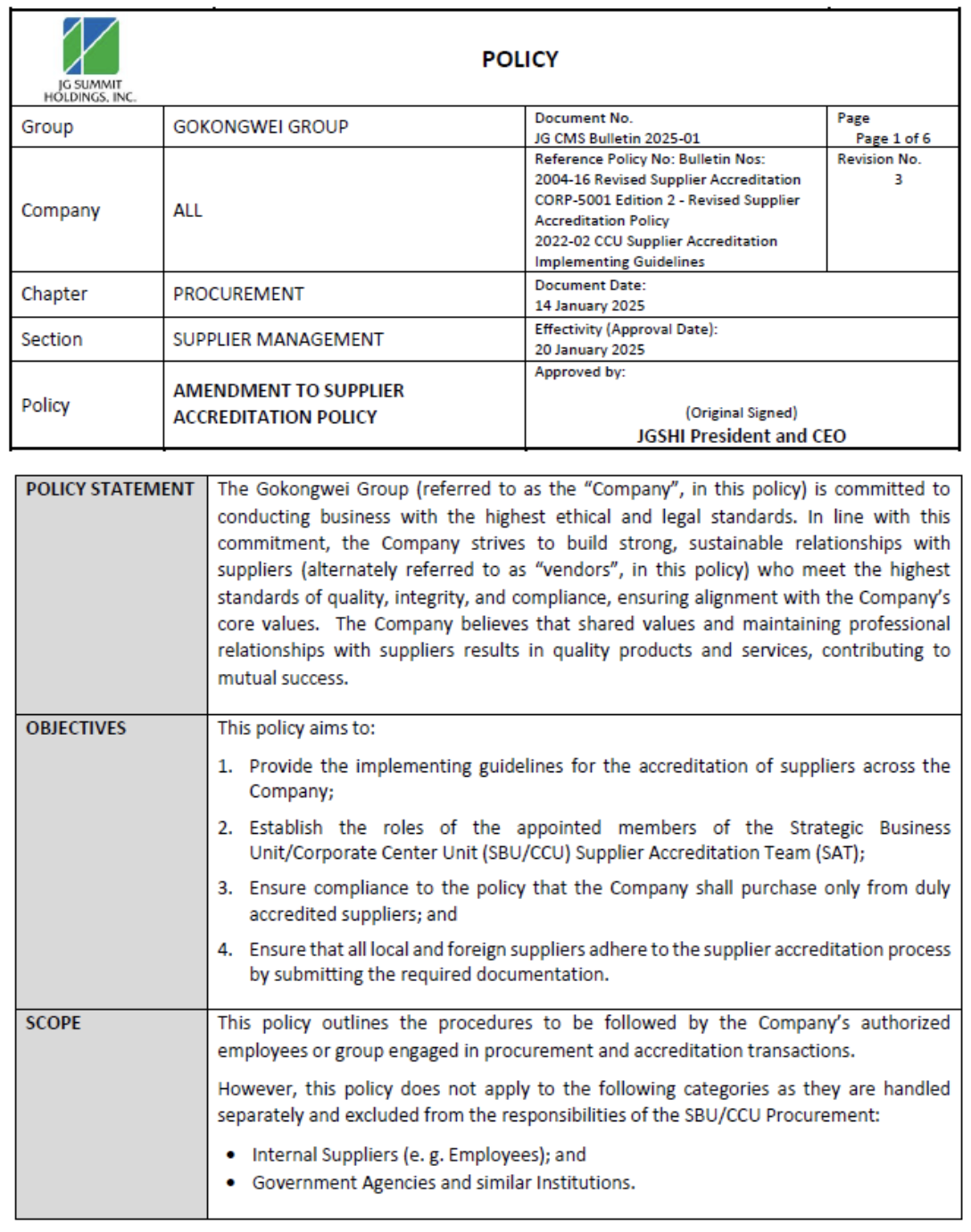
Execution of this policy is on a per-SBU basis. JGSHI Corporate Procurement’s role is to consolidate the output from SBUs into a central supplier database and to provide the framework for policy development.
Click the image to view (6 pages)
2025 Stakeholder Engagement Results
Effective stakeholder engagement enables JG Summit to identify issues and concerns that may influence its long-term performance and resilience. By proactively consulting and collaborating with stakeholders, the company gains insights into their expectations, priorities, and emerging risks, allowing it to respond effectively and responsibly.
Incorporating stakeholder feedback into decision-making strengthens partnerships, addresses shared challenges, and drives positive, lasting impact. This engagement supports continuous improvement, aligns business strategies with societal expectations, and reinforces JG Summit’s commitment to responsible and sustainable practices.
Investors and Shareholders
- Financial growth and profitability
- Ethical standards for governance and business conduct
- Commitment and targets related to social and environmental responsibility, especially on Climate Change
- Resilience and strategy against key business and sustainability risks
- Result briefings through Quarterly and Annual Reports
- Annual stockholder meetings
- Disclosures to the Philippine Stock Exchange and other pertinent agencies
- Meetings with investors
- Oversight of the Board through its Governance, Nomination, Remuneration and Sustainability Committee (GNRSC)
- Correspondence with ESG rating agencies (e.g., CDP, MSCI)
- Continuous development of business strategy to improve financial and operational performance
- Compliance with laws and regulations
- Adherence to good governance principles
- Incorporation of sustainability to business strategy
- Enhanced sustainability disclosure to include strategy to reach targets along with milestones
- Communication of received feedback to top management through Executive Leadership Council (ELC) meetings to further incorporate sustainability into business strategy
- Enhanced ERM policies, systems, and procedures
Employees
- Competitive compensation and benefits
- Frequent career conversations between employees and their managers
- Exposure to career advancement opportunities
- Positive work culture driven by purpose, values, and community
- Town hall meetings
- Open dialogues
- Pulse Employee Engagement Survey
- Continuous benchmarking and regular review of total rewards to ensure competitive salaries, benefits, incentives, and employee growth initiatives, including formal and e-training programs
- Active talent management through a strong HR-leadership partnership, covering performance management, career development discussions, and structured promotion and compensation processes
- Structured employee engagement and purpose-driven initiatives, including town halls and other communication platforms, to foster a positive work culture, strengthen group identity, and build community
- Adherence to good labor practices and workplace standards to promote fair, safe, and responsible employment conditions
Suppliers and Service Providers
- Lasting business commitments
- Complying with sustainability policies of JGSHI
- Timely payment
- Vendor audits
- Open line communication
- Execution of purchasing ethics, strategic purchasing, and supplier relationship management
- Strict implementation of Supplier Accreditation Policy
- Practice of due diligence in processing liabilities
Regulators and Government Bodies
- Legal compliance with laws and regulations
- Comments and improvements on legislative proposals
- Partnership in social and environmental responsibility
- Feedback and suggestions on existing policies, laws, and regulations affecting our other stakeholders
- Engagement with LGUs and creation of a database of their leaders
- Annual and Sustainability Reports
- Statement of compliance
- Licenses to operate
- Position Papers
- Corporate social responsibility programs
- Association and/or community engagement with discussion regarding policies, laws, and regulations affecting the association members and/or communities
- Establishment with LGU leaders, to be led by the Sustainability team, as it is the same team handling Community Relations for the Gokongwei Group
- Compliance with laws and regulations
- Submission of official position papers on legislative proposals
- Implementation of initiatives to support government programs (e.g., Lingkod Pinoy Centers and tree planting)
- Drafting and submission of feedback and suggestions for and on behalf of the Association and/or community
- Introduction of the team to the leaders, especially if newly elected
Communities
- Community engagement and development
- Responsible environmental management
- Corporate social responsibility programs
- Environmental compliance programs
- Continuous development and design of projects and programs that respond to community needs
- Compliance with environmental standards
Customers of SBUs
- Product quality
- Health and safety
- Marketing and labelling
- Data Privacy
- Open communication channels
- Customer Satisfaction Survey
- Quality assurance for products and services of each SBU
- Implementation of environmental, safety, and quality standards and assurance systems
- Proper marketing and labelling for product content, usage, and service inclusions
- Enhanced JGSHI-wide information security system to prevent any data leak and security breach
Annex B. Philippine SEC Sustainability Reporting for Publicly Listed Companies Content Index
Annex C. ISSB Climate Disclosure Index (IFRS - S1 and S2)
| Pillar | Climate Disclosure | Section |
|---|---|---|
| Governance | a. Board’s oversight of sustainability and climate-related risks and opportunities | Our Management Approach – Governance |
| b. Management’s role in assessing and managing sustainability and climate-related risks and opportunities | Our Management Approach – Governance | |
| Risk Management | a. Processes and related policies the entity uses to identify, assess, prioritize, and monitor sustainability and climate-related risks | Our Management Approach – Sustainability and Climate Risk Management |
| b. Processes used to identify, assess, prioritize, and monitor sustainability and climate-related opportunities | Our Management Approach – Sustainability and Climate Risk Management | |
| c. Processes for identifying, assessing, and managing sustainability and climate-related risks that are integrated into the organization’s overall risk management | Our Management Approach – Sustainability and Climate Risk Management | |
| Strategy | a. Sustainability and climate-related risks and opportunities that the organization has identified | Our Management Approach – Strategy, Metrics and Targets, 2025 Stakeholder Engagement Results |
| b. Impact of sustainability and climate-related risks and opportunities on the organization’s businesses, strategy, and financial planning | Our Management Approach – Strategy, Metrics and Targets, 2025 Stakeholder Engagement Results | |
| c. Resilience of the organization’s strategy, taking into consideration different sustainability and climate-related scenarios | Our Management Approach – Strategy, Metrics and Targets, 2025 Stakeholder Engagement Results, Our approach and strategy in climate resilience | |
| Metrics and Targets | a. Metrics used by the organization to assess sustainability and climate-related risks and opportunities in line with its strategy and risk management process | Our Management Approach – Strategy, Metrics, and Targets |
| b. Scope 1, Scope 2, and Scope 3 greenhouse gas (GHG) emissions, and the related risks | EESG Performance Indices – Environmental Performance | |
| c. Targets used by the organization to manage climate-related risks and opportunities, and performance against targets | Our Management Approach – Strategy, Metrics, and Targets |
Annex D. GRI Content Index
Statement of use
JG Summit Holdings, Inc. has reported the information cited in this GRI content index for the period January 1 to December 31, 2025, with reference to the GRI Standards.
GRI 1 used
GRI 1: Foundation 2021
| GRI Standard | Disclosure | Section or Direct Answer |
|---|---|---|
| GRI 2: General Disclosures 2021 | 2-1 Organizational details | Our Company |
| 2-2 Entities included in the organization’s sustainability reporting | Corporate Structure, Strategic Business Units | |
| 2-3 Reporting period, frequency and contact point | January 1–December 31, 2025, Corporate Directory | |
| 2-4 Restatements of information | EESG Performance Indices – Environmental Performance | |
| 2-5 External assurance | This report is not externally assured. | |
| 2-7 Employees | EESG Performance Indices – Employee Data | |
| 2-9 Governance structure and composition | Corporate Governance | |
| 2-10 Nomination and selection of the highest governance body | The Board of Directors, Board and Board Committees | |
| 2-11 Chair of the highest governance body | The Board of Directors | |
| 2-12 Role of the highest governance body in overseeing the management of impacts | Corporate Governance, 2025 Stakeholder Engagement Results | |
| 2-13 Delegation of responsibility for managing impacts | Corporate Governance | |
| 2-14 Role of the highest governance body in sustainability reporting | Governance Framework, GNRSC Roles and Functions | |
| 2-15 Conflicts of interest | Code of Business Conduct and Ethics, Compliance Monitoring and Implementation | |
| 2-16 Communication of critical concerns | Compliance Monitoring and Implementation | |
| 2-17 Collective knowledge of the highest governance body | Board Competencies, Board Trainings | |
| 2-18 Evaluation of the performance of the highest governance body | Board Performance Assessment | |
| 2-19 Remuneration policies | Succession Planning and Remuneration, Remuneration | |
| 2-20 Process to determine remuneration | Succession Planning and Remuneration, Remuneration | |
| 2-21 Annual total compensation ratio | Composition and Qualification, Remuneration | |
| 2-22 Statement on sustainable development strategy | Sustainability at JGSHI, Strategy, Metrics, and Targets | |
| 2-23 Policy commitments | Corporate Governance Policies, Labor Management Relations, EESG Performance Indices - Governance, Supplier Accreditation | |
| 2-24 Embedding policy commitments | Corporate Governance Policies, Labor Management Relations, EESG Performance Indices - Governance, Supplier Accreditation | |
| 2-25 Processes to remediate negative impacts | Compliance Monitoring and Implementation, Employee Training and Development | |
| 2-26 Mechanisms for seeking advice and raising concerns | Compliance Monitoring and Implementation, 2025 Stakeholder Engagement Results | |
| 2-27 Compliance with laws and regulations | Compliance Reports, Internal Controls, Governance Programs, Non-compliance with Environmental Laws and Regulations, Labor Management Relations | |
| 2-28 Membership associations | JGSHI is a member of the Makati Business Club (MBC), which is a private, non-profit business association in the Philippines. Established in 1981, MBC represents the interests of the country’s largest and most prominent businesses, including major corporations and conglomerates. It serves as a forum for discussion on economic, political, and social issues affecting the business environment in the Philippines. MBC engages in policy advocacy, publishes research and reports, and facilitates dialogues between the private sector and government. The organization aims to promote good governance, transparency, and sustainable economic development in the country. It is also involved in various initiatives that support business growth, social responsibility, and national competitiveness. JGSHI is also a member of the Philippine Alliance for Recycling and Materials Sustainability (PARMS), which is a non-profit, multi-stakeholder coalition that promotes recycling and materials sustainability in the Philippines. Established in 2014, PARMS brings together various sectors, including businesses, government agencies, non-governmental organizations (NGOs), academic institutions, and communities, to collaborate on solutions for waste management and environmental sustainability. The alliance aims to address the country's growing waste problem through initiatives such as developing sustainable packaging solutions, promoting recycling practices, and advocating for policies that support a circular economy. PARMS focuses on educating the public, raising awareness about the importance of responsible waste management, and supporting innovations in recycling and sustainable materials use. PARMS is known for its commitment to working towards zero waste and a more sustainable future by fostering partnerships among its members and stakeholders, which include some of the largest companies and organizations in the Philippines. |
|
| 2-29 Approach to stakeholder engagement | 2025 Stakeholder Engagement Results | |
| 2-30 Collective bargaining agreements | Labor Management Relations | |
| GRI 3: Material Topics 2021 | 3-1 Process to determine material topics | Strategy, Metrics, and Targets, 2025 Stakeholder Engagement Results |
| 3-2 List of material topics | Sustainability at JGSHI, Our Impact, 2025 Stakeholder Engagement Results | |
| 3-3 Management of material topics | Our Impact | |
| GRI 201: Economic Performance 2016 | 201-1 Direct economic value generated and distributed | Our Impact – Shared Success, Sustainability Performance Scorecard |
| 201-2 Financial implications and other risks and opportunities due to climate change | Risk Categories – Climate Risk, Sustainability and Climate Risk and Opportunity Management Framework | |
| GRI 202: Market Presence 2016 | 202-1 Ratios of standard entry level wage by gender compared to local minimum wage | Employee Data |
| GRI 204: Procurement Practices 2016 | 204-1 Proportion of spending on local suppliers | EESG Performance Indices – Procurement Practices |
| GRI 205: Anti-corruption 2016 | 205-1 Operations assessed for risks related to corruption | Compliance Monitoring and Implementation, Risk Categories – Governance Risk |
| 205-2 Communication and training about anti-corruption policies and procedures | Board Trainings, EESG Performance Indices – Governance | |
| 205-3 Confirmed incidents of corruption and actions taken | EESG Performance Indices – Governance | |
| GRI 301: Materials 2016 | 301-1 Materials used by weight or volume | EESG Performance Indices – Environmental Performance |
| 301-2 Recycled input materials used | EESG Performance Indices – Environmental Performance | |
| GRI 302: Energy 2016 | 302-1 Energy consumption within the organization | EESG Performance Indices – Environmental Performance |
| 302-3 Energy intensity | EESG Performance Indices – Environmental Performance | |
| 302-4 Reduction of energy consumption | Our Impact – Climate Action, EESG Performance Indices – Environmental Performance | |
| GRI 303: Water and Effluents 2018 | 303-1 Interactions with water as a shared resource | EESG Performance Indices – Environmental Performance |
| 303-2 Management of water discharge-related impacts | Our Impact – Resource Efficiency and Circularity, EESG Performance Indices – Environmental Performance | |
| 303-3 Water withdrawal | EESG Performance Indices – Environmental Performance | |
| 303-4 Water discharge | EESG Performance Indices – Environmental Performance | |
| 303-5 Water consumption | EESG Performance Indices – Environmental Performance | |
| GRI 305: Emissions 2016 | 305-1 Direct (Scope 1) GHG emissions | EESG Performance Indices – Environmental Performance |
| 305-2 Energy indirect (Scope 2) GHG emissions | EESG Performance Indices – Environmental Performance | |
| 305-3 Other indirect (Scope 3) GHG emissions | EESG Performance Indices – Environmental Performance | |
| 305-4 GHG emissions intensity | EESG Performance Indices – Environmental Performance | |
| 305-5 Reduction of GHG emissions | Our Impact – Climate Action, EESG Performance Indices – Environmental Performance | |
| 305-6 Emissions of ozone-depleting substances (ODS) | EESG Performance Indices – Environmental Performance | |
| 305-7 Nitrogen oxides (NOx, sulfur oxides (SOx), and other significant air emissions | EESG Performance Indices – Environmental Performance | |
| GRI 306: Waste 2020 | 306-1 Waste generation and significant waste-related impacts | Our Impact – Resource Efficiency and Circularity |
| 306-2 Management of significant waste-related impacts | Our Impact – Resource Efficiency and Circularity | |
| 306-3 Waste generated | EESG Performance Indices – Environmental Performance | |
| 306-4 Waste diverted from disposal | EESG Performance Indices – Environmental Performance | |
| 306-5 Waste directed to disposal | EESG Performance Indices – Environmental Performance | |
| GRI 401: Employment 2016 | 401-1 New employee hires and employee turnover | EESG Performance Indices – Social |
| 401-2 Benefits provided to full-time employees that are not provided to temporary or part-time employees | EESG Performance Indices – Social | |
| 401-3 Parental leave | EESG Performance Indices – Social | |
| GRI 403: Occupational Health and Safety 2018 | 403-1 Occupational health and safety management system | EESG Performance Indices – Social, Our Impact – Employee Growth and Well-Being |
| 403-2 Hazard identification, risk assessment, and incident investigation | Enterprise Risk Management | |
| 403-3 Occupational health services | Duties to Stakeholders – Employees | |
| 403-5 Worker training on occupational health and safety | Our Impact – Employee Growth and Well-Being | |
| 403-6 Promotion of worker health | Duties to Stakeholders – Employees, Risk Categories – People Risk, EESG Performance Indices – Social | |
| 403-9 Work-related injuries | EESG Performance Indices – Social | |
| 403-10 Work-related ill health | EESG Performance Indices – Social | |
| GRI 404: Training and Education 2016 | 404-1 Average hours of training per year per employee | EESG Performance Indices – Social |
| 404-2 Programs for upgrading employee skills and transition assistance programs | Our Impact – Better Choices, EESG Performance Indices – Social | |
| GRI 405: Diversity and Equal Opportunity 2016 | 405-1 Diversity of governance bodies and employees | Corporate Governance Policies, Board Diversity, EESG Performance Indices – Social |
| GRI 407: Freedom of Association and Collective Bargaining 2016 | 407-1 Operations and suppliers in which the right to freedom of association and collective bargaining may be at risk | EESG Performance Indices – Social |
| GRI 408: Child Labor 2016 | 408-1 Operations and suppliers at significant risk for incidents of child labor | EESG Performance Indices – Social |
| GRI 409: Forced or Compulsory Labor 2016 | 409-1 Operations and suppliers at significant risk for incidents of forced or compulsory labor | EESG Performance Indices – Social |
| GRI 413: Local Communities 2016 | 413-1 Operations with local community engagement, impact assessments, and development programs | Our Impact – Shared Success, EESG Performance Indices – Biodiversity |
| 413-2 Operations with significant actual and potential negative impacts on local communities | Our Impact – Shared Success, EESG Performance Indices – Biodiversity | |
| GRI 416: Customer Health and Safety 2016 | 416-2 Incidents of non-compliance concerning the health and safety impacts of products and services |
EESG Performance Indices – Governance URC Food Safety and Quality Management Commitment URC is committed to maintaining the highest standards of Quality and Food Safety across all aspects of its operations. This commitment is aligned with current global standards and reinforced through internal policies and procedures, ensuring that products consistently meet the expectations of consumers and stakeholders. To strengthen this commitment, URC continues to enhance its initiatives, including the implementation of the One GMP (Good Manufacturing Practices) Requirements and the URC Operational Requirements (URCORe) Integrated Quality and Food Safety Standards. URCORe provides a comprehensive framework for establishing robust management systems that support business continuity through clear standards governance, structured documentation, and a centralized platform for accessing operational requirements across all URC sites. The Global Quality and Food Safety Team continues to advance systems and processes to further strengthen quality and food safety performance through the following initiatives:
--------------------------------------------------------------- Passenger safety remains Cebu Pacific’s top priority. It continues to implement strict safety measures designed to reassure travelers and protect the public from unnecessary dangers. Wildlife Management Wildlife management is crucial for Cebu Pacific because wildlife strikes (especially bird strikes) pose serious safety risks to aircraft during any phase of flight. These strikes can damage engines and critical aircraft structures, endanger passengers and crew, and in rare cases lead to accidents. Effective wildlife management around airports also reduces flight delays, cancellations, and costly repairs, helping airlines maintain operational reliability. Additionally, it supports regulatory compliance, reduces insurance and maintenance costs, and helps protect surrounding biodiversity from harm. Bird strike risks at Cebu Pacific are under the jurisdiction of its Wildlife Hazard Management Program (WHMP). This program ensures that Cebu Pacific has a comprehensive bird strike incident mitigation strategy across all its hubs, and closely works with airport and aviation personnel to reduce bird strike risks. Cebu Pacific values the safety of its passengers, and plans to explore and test new technological advancements to enhance the WHMP in high-risk stations. In doing so and by ensuring that partnerships with airport authorities, staff, and LGUs are sustained, Cebu Pacific continues to uphold its commitment to safer skies for everyone. Customer Journey Management In addition to the WHMP, which mitigates the risk of bird strikes, Cebu Pacific implements other initiatives to protect passengers and maintain public confidence in air travel. Across its areas of operation, Cebu Pacific designates trained first aid responders and safety officers within its offices to provide immediate assistance to employees. For 62 passengers, the cabin crew is responsible for delivering first aid and immediate attention as needed during flights. Cebu Pacific also continuously strengthens its crisis and disruption management through the Customer Journey Management Team (CJMT), established in 2023 to ensure passengers’ welfare and safety during operational disruptions. The CJMT addresses issues such as delayed updates, poor coordination, outdated communications, multiple AOGs, extended turnaround times, and customer dissatisfaction at different touchpoints. It implements proactive measures, including real-time internal updates, timely passenger announcements, recovery actions (rebooking, food, accommodations), and efficient complaint handling, ensuring safe and smooth passenger movement across check-in counters, boarding gates, and service areas. By shifting the organization’s focus from purely operational metrics to prioritizing customer safety and satisfaction, the CJMT has driven tangible results, including a 100% increase in customer net promoter score (NPS), from +14 to +28, even with a growing passenger base. The team has enhanced operational resilience by improving response times and on-ground coordination, reducing the need for crisis activations during disruptions such as typhoons. Looking ahead, the CJMT continues to identify inefficiencies, trial new tools, and gather passenger feedback, reinforcing Cebu Pacific’s commitment to safe, efficient, and customer-focused disruption management. Source: PSE Disclosure Form 17-1 - Annual Report (as of 31 December 2025) 28 March 2026, p.393–394 --------------------------------------------------------------- From the design and construction of properties to their operation, RLC takes measures to reduce health and safety risks to both employees and customers. Structural threats are minimized by meeting the highest building standards, and risks of slippage and fall are regularly assessed and audited. Source: RLC_SEC 17-A_December 31 2025, p. 144 |
| GRI 417: Marketing and Labeling 2016 | 417-3 Incidents of non-compliance concerning marketing communications |
EESG Performance Indices – Governance URC adheres closely to the Philippine Food Safety Act (Republic Act or R.A. 10611), which protects consumer health and safety. Regulatory compliance encompasses product registration, sale, inspection, labeling, and marketing. URC ensures full compliance with regulatory labeling and product information requirements, implementing the necessary analysis for nutritional facts and claims. ![]() ![]() Source: URC SEC 17A Form Dec 31 2025 --------------------------------------------------------------- In 2025, Cebu Pacific rapidly grew its brand valuation. According to Brand Finance’s Philippines 2025 brand rankings, Cebu Pacific was highlighted as one of the top-performing Philippine brands, particularly noted as the fastest-growing brand in the country. Taking advantage of growing passenger numbers and revenues in 2025, Cebu Pacific cemented its rising relevance within key markets. Brand Finance awarded Cebu Pacific an AAA brand rating, one of the highest possible designations, paired with a BSI score of 86.1 out of 100—signaling robust consumer perception and competitive strength in the airline sector. 2025 was a milestone year for Cebu Pacific’s brand valuation. It showcased significant growth, strong equity, and regional recognition while continuing its strategy as a leading LCC in Southeast Asia.
Source: PSE Disclosure Form 17-1 - Annual Report (as of 31 December 2025) 28 March 2026, p. 394–395 |
| GRI 418: Customer Privacy 2016 | 418-1 Substantiated complaints concerning breaches of customer privacy and losses of customer data | EESG Performance Indices – Governance |